
Into the Pines by Andrew Adams
The Pause that Saved the Pines
New Jersey’s history of pausing development in order to protect the Pinelands provides a model to manage the glut of data center proposals that towns across the state are now facing.
In the summer of 1978, New Jersey did something governments rarely do: it stopped. Faced with mounting pressure to open the Pine Barrens to large-scale development, the state imposed a development moratorium on the region. It was a blunt instrument, but time has shown that it was the right one.
The moratorium, enacted through the Pinelands Review Committee established by Governor Brendan Byrne, halted major development while planners, scientists, and policymakers worked out what the Pinelands actually were and what protecting them would require. At stake was a million-acre expanse of coastal plain sitting between Philadelphia and Atlantic City, underlain by one of the largest unconfined aquifers on the Eastern Seaboard: the Kirkwood-Cohansey Aquifer. That exercise in deliberate restraint — unglamorous, contested, and temporary by design — created the conditions for good decisions to be made.
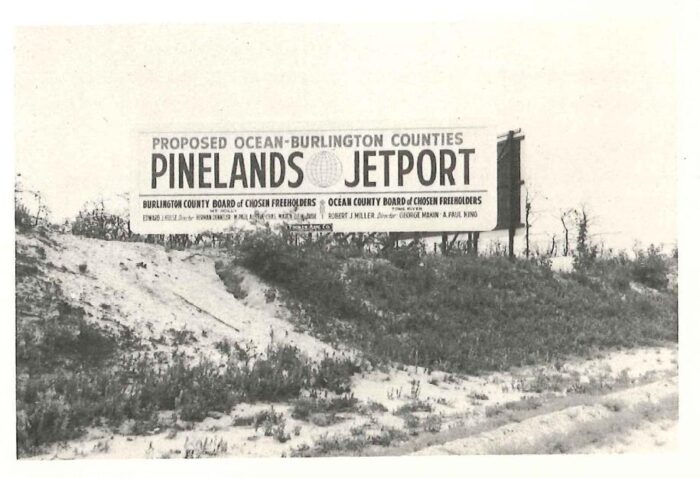
To understand why, it helps to understand what the Pinelands faced in the mid-1970’s. The region had spent decades being underestimated. Its acidic, nutrient-poor soils made conventional agriculture difficult, and its dense scrub oak and pitch pine forests struck developers as an obstacle rather than an asset. But the suburban building boom of the post-war era changed the calculus for developers with a growing appetite for land in proximity to cities like Philadelphia. What they saw was proximity: the Pines lay within an hour’s drive of two major metropolitan areas. Plans circulated for a new international jetport. Residential subdivisions were advancing from the edges. Without intervention, the Pinelands’ fate was likely to follow that of much of the Jersey Shore’s hinterland — absorbed, incrementally and irrevocably, into the suburban sprawl radiating outward from Camden and Trenton and the Shore towns.
Time: the Critical Ingredient
The ecological arguments for protection were already well-developed. The Kirkwood-Cohansey aquifer system holds an estimated 17 trillion gallons of some of the purest freshwater on the continent. The Pinelands support globally rare plant communities adapted to periodic fire and acidic soils, including several carnivorous species found nowhere else in the state. The region contains habitat for the federally threatened Pine Barrens treefrog and serves as a migratory corridor for dozens of bird species. These facts were documented, but documentation is not legislation. Between knowing what is at stake and building the legal and institutional machinery to protect it, there is a great deal of work to be done.
That work requires time that active development pressure does not permit, and is exactly what the moratorium provided. Beginning in 1978, the development pause created the conditions for two overlapping processes to unfold without the clock running against them. At the federal level, Congress was moving toward passage of the National Parks and Recreation Act of 1978, which would designate the Pinelands the nation’s first National Reserve and direct the state to develop a regional management plan — a mandate with real teeth but no prescriptive blueprint. At the state level, Byrne’s administration was assembling the evidence base, the stakeholder engagement, and the legislative consensus needed to create a permanent governance structure. Neither process could have proceeded coherently while bulldozers were advancing across the landscape. The moratorium made the timeline workable.
The New Jersey Pinelands Commission was established by statute in 1979. Its charge was to develop a Comprehensive Management Plan that would govern land use across more than a million acres, balancing conservation requirements with the rights of the region’s existing communities. The CMP, adopted in 1980, was the product of that deliberative window. It established a graduated land use framework, identified Preservation and Protection Areas with the most stringent controls, and created Agricultural Production Areas and Rural Development Areas where economic activity could continue under defined standards. It was, and remains, one of the most sophisticated regional planning documents in American history.
Durable, Effective Policy Takes Time
None of that complexity was available off the shelf. It had to be built — through ecological surveys, legal analysis, community meetings, intergovernmental negotiation between fifteen municipalities and seven counties and the state and federal governments, and a level of democratic legitimacy that takes time to establish. A moratorium bought that time. A moratorium, notably, that was itself a form of regulation — not a ban on all activity, but a pause on the specific category of large-scale development most likely to foreclose options before the planning process could establish what those options should be.
The CMP has not been static. It has been amended, challenged, and periodically updated to address issues its framers could not have fully anticipated. Agricultural exemptions have been interpreted in ways that strain the document’s original intent. The boundary of the Pinelands Area has been subject to persistent political pressure. Individual permit decisions have occasionally revealed the gap between the plan’s protective framework and its practical administration. None of this is a surprise, but each instance has provided an opportunity to continually improve the plan.
But the baseline holds. The Kirkwood-Cohansey aquifer remains largely intact beneath more than a million acres of mostly unfragmented forest. The treefrog persists. The blueberry and cranberry operations that define the agricultural character of places like Hammonton and Chatsworth continue under a framework that recognizes their role in the working landscape. The regional planning structure established in 1980 has proven durable enough to withstand multiple gubernatorial administrations with varying levels of enthusiasm for land conservation. That durability was purchased in 1978 by a government that recognized — rightly — that the thing it was trying to protect could not wait for the planning and legislation to catch up to the development.
Pinelands History Holds Lessons for Today
The lesson is not complicated, but it bears repeating whenever a comparable situation arises: when the resource at stake is irreplaceable and the pressure on it is immediate, the first obligation is to create the conditions for good decisions. The new generation of data centers being built across the United States, including New Jersey, is adding unprecedented demand to our energy and water infrastructure. They also have major impacts to host communities, that are subjected to the constant noise and pollution of hastily-built data centers.
The warehouse boom of the pandemic era was a warm-up test that our planning systems failed. Warehouses were built in inappropriate locations, subjecting residents of small communities to disproportionate impacts. Many of these warehouses still sit empty, waiting for a tenant that may never come, because the zeal of developers was greater than the actual demand.
Municipalities like Pemberton Township learned their lesson from the warehouse boom, and have quickly moved to ban data centers from their towns. They learned to be proactive, in the absence of real leadership from state-wide leaders like the Governor. Diversions with half-measures like Sherill’s 4-point plan to put “guardrails” on data centers provide little comfort to communities in the crosshairs of developers.
Recent polling shows that 65% of New Jerseyans support a ban on new data centers until our energy crisis is addressed. The Pinelands Alliance petition calling for a moratorium has garnered over 9,000 signatures, and the support of over 60 organizations. NJ Senator Frank Pallone Jr. has indicated support for a national moratorium. So why has a moratorium taken a backseat to the bevvy of bills that we’ve seen rushed through the legislature? These half-measures nibble around the edges, rather than cutting to the heart of the problem.
Although the threats posed by data centers are relatively new, New Jersey’s history offers wisdom that can be applied to our modern challenges. The Pinelands Commission marks its work today against a plan that was written in a window opened by a moratorium. The forests, water, and wildlife are still there. It shows that a pause is not a failure of action, and may actually be one of the most important tools available to address an existential threat.
This is a break-the-glass moment to brandish our trusty tool: the moratorium. It worked to protect the Pinelands decades ago, and it can do the job again to protect New Jersey for current and future generations.
