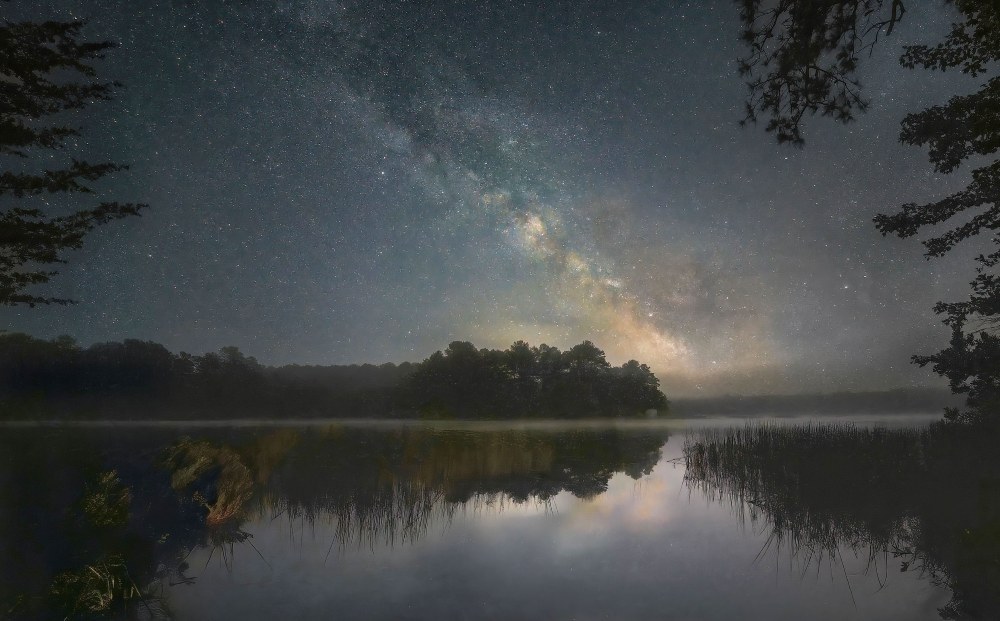
The Milky Way rising over a foggy Lake Absegami in Bass River-State Forest by Audrey Geddes
From Earthrise to Moonshot: The Next Pinelands Movement
Can the Artemis II Mission Inspire a New Environmental Movement Like Apollo 8, for the Pinelands, In the Face of Climate Change?
Earth Day is an annual celebration in which individuals join community cleanups and post photos of themselves enjoying nature on social media. Over time, Earth Day has expanded into Earth Month —a season for reflection, education, and action. This year, Earth Month was kicked off with the first moon mission in more than half a century, as NASA’s Artemis II mission sent a team of astronauts on a 10-day journey around the moon. This mission offered something bigger than technological achievement alone: it gave us a renewed chance to see Earth, and our responsibility to protect it, with fresh eyes. More than 50 years ago, a similar moment changed history.
The Beginning of the Environmental Movement
The environmental movement began largely in response to Apollo 8’s mission to the moon. Astronauts captured the iconic “Earthrise” photograph, which shows a fragile blue-and-white world floating alone in the vast darkness of space. That single image helped transform public consciousness. Combined with Rachel Carson’s Silent Spring and growing awareness of pollution, Apollo 8 helped inspire the modern environmental movement. At that time, there was no federal environmental protection agency or policies to protect shared resources like clean water and clean air. As a result of this shift in consciousness, Americans began to understand that Earth was not an endless frontier—it was a singular, vulnerable home.
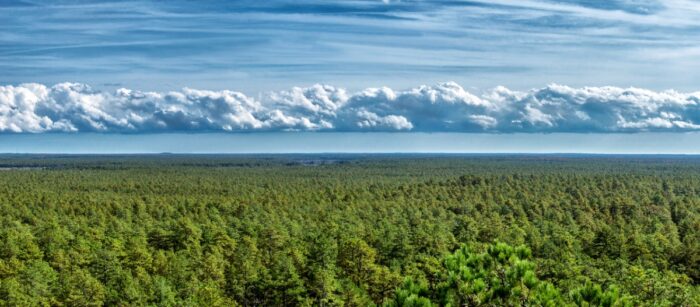
The First Earth Day
That awakening led directly to the first Earth Day on April 22, 1970. The effort was largely supported by Gaylord Nelson, a democratic senator from Wisconsin. The turnout was incredible. Described as “one of the most remarkable happenings in the history of democracy” by American Heritage magazine, almost 20 million Americans, roughly 10% of the entire population at the time. The Civil Rights Movement laid the groundwork for Earth Day tactics, such as teach-ins, mass mobilization, and grassroots leadership.
That same year, by December 1970, Congress authorized the creation of the Environmental Protection Agency. The following years saw the passage of environmental laws such as the Clean Air Act, the Clean Water Act, the Endangered Species Act, the National Environmental Policy Act, and the Occupational Safety and Health Act.
Artemis II
The pollution that brought about the environmental movement during the Apollo 8 mission has been reduced thanks to the movement’s strong support. However, we face new environmental challenges. As Earth Day 2026 passed and Artemis II rounded the moon, setting the stage for humans to build on the moon, we can reflect on a new take on the “overview effect,” a phenomenon that occurs when astronauts see Earth from space and can shift their perspectives on life itself. The astronauts gained life-changing perspectives from their new journey. The Artemis II astronauts reflect on their journey around the moon and back to Earth. Artemis II commander Reid Wiseman described it simply—after venturing so far, “you just want to get back to your families and your friends. It’s a special thing to be a human, and it’s a special thing to be on planet Earth”. NASA’s Christina Koch captured a similar sentiment about the trajectory of human achievement, saying “We will explore. We will build… But ultimately, we will always choose Earth. We will always choose each other.” That perspective feels especially urgent in the age of climate change.
Can we channel this inspiration from the astronauts in 2026, as we did with the Apollo 8 mission in 1968? As climate change has already impacted communities and lives around the world, there is a need for another turn-out like the one on Earth Day that helped create the environmental movement. Can the torch be carried, inspired by the movement in the late 60’s, to take on the greatest threat to humanity?
While global challenges can feel overwhelming, one of America’s greatest environmental success stories is visible right here in New Jersey—and remarkably, it can be seen from space.
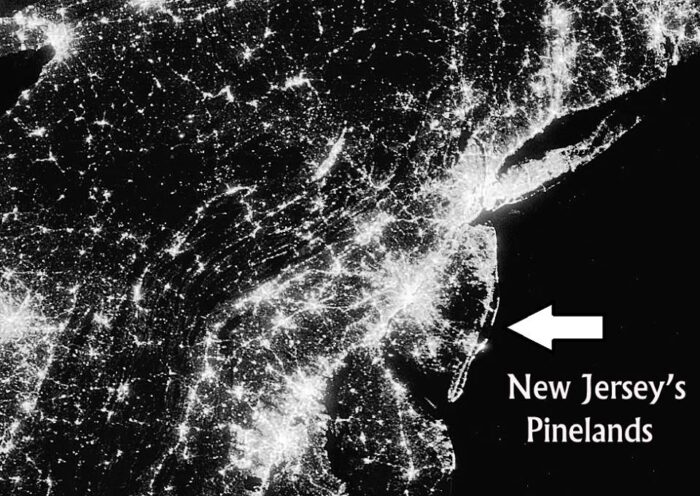
Look at satellite imagery of South Jersey at night, and amid the sprawling lights of Philadelphia, Camden, Atlantic City, and surrounding suburbs, one feature stands out: a vast, dark, development-free expanse in the center of the region. That “hole” is the New Jersey Pinelands.
Covering more than one million acres, the Pinelands remain one of the largest preserved open spaces on the Eastern Seaboard—not by accident, but because generations of advocates fought to protect it. The landmark Pinelands Comprehensive Management Plan (CMP), established after years of organizing and scientific advocacy, created one of the strongest regional land-use frameworks in the nation. Organizations like the Pinelands Alliance have spent decades defending that framework, resisting destructive development, protecting water resources, and ensuring that this globally rare forest ecosystem remains intact.
The result is extraordinary: from orbit, the Pinelands appear as a dark green heart in South Jersey, a living testament to what environmental policy, citizen activism, and long-term vision can accomplish.
In a world where forests are too often fragmented, paved, or burned, the Pinelands stand as proof that preservation works. And that work continues.
Pinelands Alliance: One Giant Leap for the Pinelands
Today, climate change presents a challenge as profound as the industrial pollution crisis that sparked the first Earth Day. Rising temperatures, intensifying wildfires, habitat loss, and water threats demand a new generation of environmental leadership. This year, the Pinelands Alliance is focused on climate change through policy work, including the Polluter Pays Act and the Green Amendment, while continuing to protect critical landscapes. As the federal government prioritizes fossil fuels and the development of natural resources, organizations like the Pinelands Alliance are here to support communities through advocacy, programming, outreach, and education to protect wild spaces.
These efforts do more than save trees. They protect the Kirkwood-Cohansey aquifer, preserve biodiversity, reduce carbon emissions, and maintain one of the East Coast’s most effective natural climate defenses. However, organizations like the Pinelands Alliance are nothing without their inspired and passionate supporters. This community support was critical to achieve important victories like the preservation of 835 acres at the Black Run Preserve, and 265 acres at the Pomona Woods Preserve. Hopefully, those new supporters whom Artemis II moved will start to see a change in society.
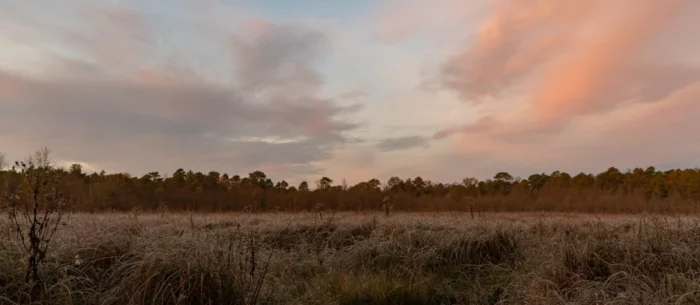
For New Jerseyans, that means recognizing the Pinelands not just as open space, but as a globally significant example of successful conservation. It means understanding that the dark patch visible from space is not emptiness—it is policy, activism, science, and public will made visible. We hope that the new Governor, Mikie Sherrill, will be among this new cohort of environmental champions.
The Pinelands should stand as both a symbol and a blueprint: proof that when people fight for the planet, even from space, you can see the difference. Artemis II astronauts have inspired the Alliance, but inspiration alone is not enough. The real mission begins here on Earth, in the everyday choices we make, the policies we fight for, and the wild places we refuse to lose. Get connected to Pinelands Alliance to stay inspired and stay active!

Are you interested in darker night skies for much better astronomy views? Would you like to help reduce migrating bird mortality at night? Want to help moths from deadly disorientation? We can do all the above by using outdoor focused light fixtures that minimize light pollution, using warmer color bulbs, and using motion sensor lights where appropriate instead of steady light.
Great article, Kayla Harris. There are moments deep in the vast stillness of Wharton State Forest when the Pine Barrens feel almost planetary — ancient, fragile, and impossibly vast all at once. It’s probably the closest many of us will ever come to experiencing something akin to the Overview Effect without leaving Earth itself.
We’re extraordinarily fortunate to have the Pinelands Alliance protecting this globally rare landscape, and equally fortunate to have thoughtful, passionate advocates like you helping connect these places to the larger story of environmental stewardship, climate resilience, and human perspective. The idea that the Pinelands can literally be seen from orbit as a dark, preserved heart in the middle of the Northeast corridor is both haunting and inspiring. Well done.
Just seeing that satellite photo of the pinelands says it all….protecting it is essential.