
Last reviewed / updated February 27, 2026
OVERVIEW
Across New Jersey, data centers are being aggressively pursued by municipalities as a new form of “economic development.” These facilities promise tax revenue and jobs, but they also bring intense environmental demands—especially for water, energy, and land. In the Pinelands, where ecological systems are unusually fragile and interconnected, these impacts are magnified.
Yet time and again, decisions that could permanently alter the region are being made quietly, early, and without meaningful public engagement, often through redevelopment designations that bypass standard notice requirements. By the time residents realize what is happening, they are told it is already too late to object.
This pattern has now emerged in Vineland and Monroe townships, and it highlights a larger structural problem: municipal governments are not equipped to evaluate or regulate the regional environmental impacts of data centers. That responsibility should go to state-wide or regional entities like the Pinelands Commission. Until we can achieve this large-scale reform, residents should pay attention to redevelopment plans being created or revised by their town councils.
Background Information
Why Data Centers Raise Red Flags in the Pinelands
Data centers are often marketed as clean, quiet, and low-impact. In reality, they can function more like industrial power and cooling plants, with consequences that ripple far beyond municipal boundaries.
Key environmental concerns include:
1. No Comprehensive Environmental Review: We see in the case of Vineland that the plan has undergone several significant changes, but no environmental impact assessment has been conducted at any point in the planning process—even as the project has evolved
from a data center to a power plant capable of producing twice as much electricity as the City of Vineland currently uses. This piecemeal evolution allows projects to evade scrutiny of their cumulative impacts.
2. Water Resource Impacts
Data centers require enormous cooling capacity, that typically requires millions of gallons of water usage per day. In the Pinelands, this raises serious concerns about drawdown from the Kirkwood–Cohansey aquifer, impacts on nearby wetlands, streams, and recharge areas, and competing water demands like residential and agricultural use.
3. Air, Noise, and Light Pollution
Data centers can generate constant or episodic pollution from backup generators, cooling fans, and mechanical systems. Cooling technology choices can significantly affect noise levels, especially in rural and residential areas not accustomed to industrial soundscapes.
5. Environmental Justice
Data centers and associated warehouses are disproportionately sited in communities with limited political power and areas already burdened by pollution, traffic, or health disparities. For example, approximately half of Vineland’s population lives in census tracts identified as overburdened by NJDEP. However, the lots associated with the DataOne project fall just outside of the area considered to be overburdened.
The Redevelopment Loophole: Zoning by Ordinance, Not by Public Process
Under New Jersey law, municipalities can designate areas as being in need of “redevelopment” or “rehabilitation” and adopt redevelopment plans that function as zoning overlays. These plans can permit uses—such as warehouses or data centers—that would otherwise be prohibited.
Critically:
· Residents within 200 feet are NOT notified when a redevelopment plan is adopted or amended
· That level of notice is only required later, when a specific project application is filed
· By then, officials often claim that the public is “too late” to object because the zoning rules have already been changed
Case Studies
Monroe Township: “Too Late” by Design
In December 2025, the Township adopted Ordinance O:02-2025, amending the Hexa Builders Redevelopment Plan to add data centers as a permitted use. Only after this amendment was adopted were residents living within 200’ of the property notified of the planned development.
This problem is now playing out again in Monroe Township (Gloucester County).
When residents raised concerns, they were told by Township Council members that:
· The redevelopment plan had already been finalized
· The relevant hearings occurred months earlier
· Public objections were no longer appropriate
This mirrors a previous Monroe Township debacle from November 2022 involving a massive warehouse and townhouse development, approved despite overwhelming resident opposition. All of this was made possible because the decisive ordinance—adopting the redevelopment plan—was passed quietly months earlier, during the height of the pandemic, with only a $64.64 newspaper notice describing an “overlay zoning district.”
Monroe Timeline
September 2019: Town Council adopts resolution R:221-2019, declaring that the area is in need of redevelopment.
February 2023: “Hexa Builders Redevelopment Plan” approved, which includes warehouses and office space as permitted uses.
March 12, 2025: Monroe Township Council adopts Ordinance O:02-2025 to add “Data Centers” as a permitted use.
December 23, 2025: Residents living within 200’ of the proposed 1.6 million square foot warehouse are given notice of the January 8, 2026 planning board meeting via certified mail. Details of the plan have given Monroe residents reason to suspect that this is actually a data center in disguise.
Current Status: The Pinelands Commission is currently reviewing application #1987-0276.012
Vineland: A Regional Problem, Not a Local One
In Vineland, similar issues have emerged around power generation and data center–related infrastructure. As with Monroe, municipal decision-making has moved forward without an assessment of environmental impacts. The lack of consideration for downstream or cross-boundary effects is especially troubling, as the data center is very close to the neighboring city of Millville, which gets no say in the decisions being made by elected officials in the city of Vineland.
Municipal governments are structured to evaluate parcel-by-parcel projects, not region-wide impacts.
Vineland Timeline
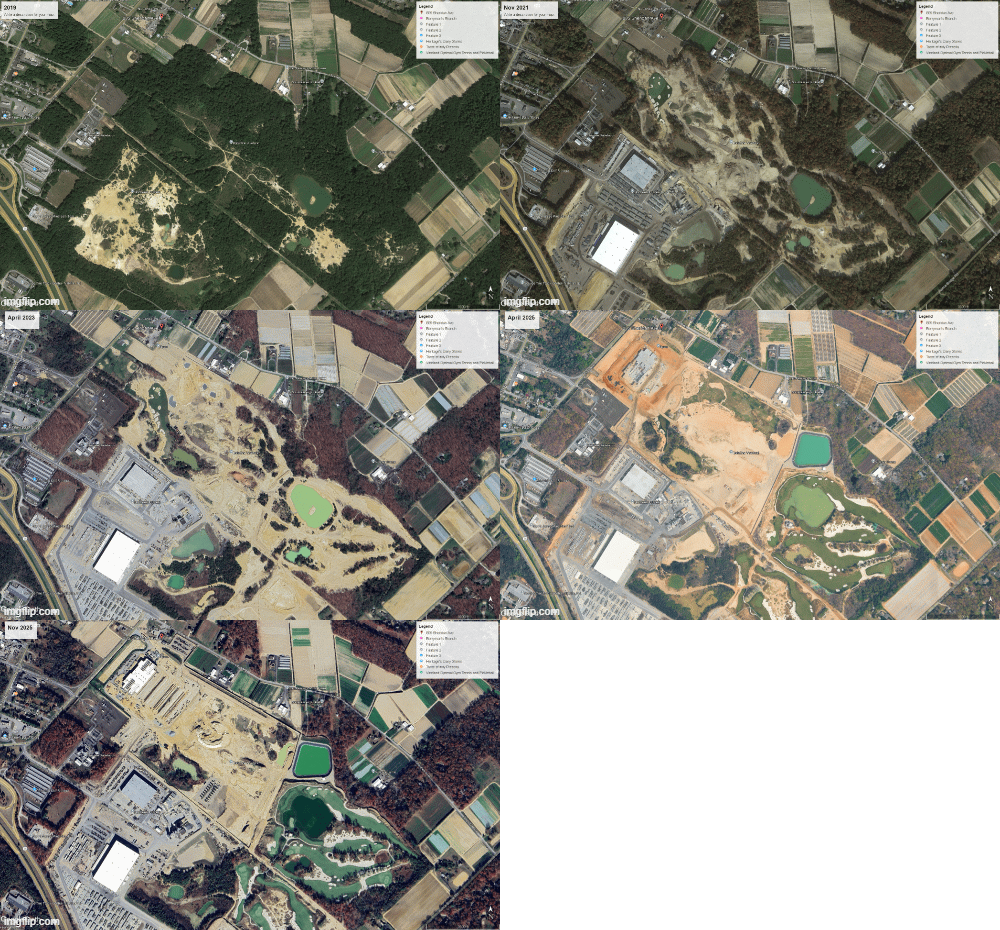
1920’s: Sand mining operations begin, and are most active in the 1960’s-1990’s. The history of the lots is described in the 2017 redevelopment area plan.
2012-2013: Zoning board approves variances that would allow new uses such as an arena and athletic fields, fitness center, daycare, medical office, large storage and maintenance buildings, waterpark, hotel. This history was described in the 2020 Redevelopment Proposal.
2017: city council passes motion to develop a plan for redevelopment area
2020: Ordinance 2020-49 adopted, plans are made for “outdoor amusement” such as a golf course and clubhouse
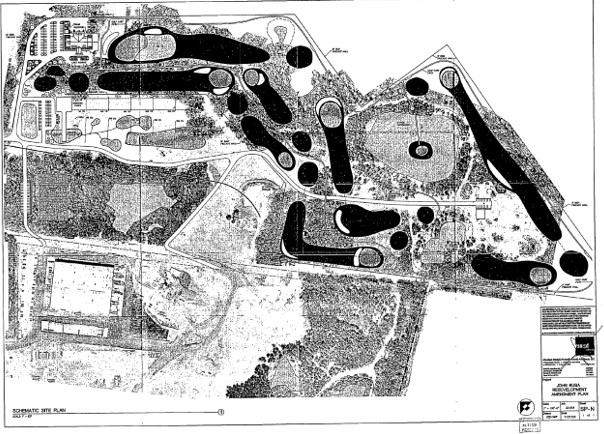
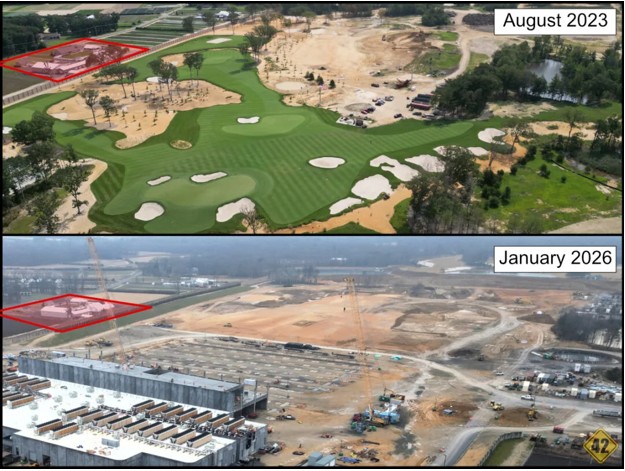
2023: Ordinance 2023-51 Amendment of the redevelopment plan to include more blocks and more potential uses, such as paintball manufacturing, cigar lounges, or distilleries (still no mention of data centers)
October 4, 2024: Newly built “Silica Sands Golf Club” hosts an event for the Greater Millville Chamber of Commerce
August 8, 2024: Resolution 6652 of the Planning Board approves an application from “NEP Real Estate of Vineland NJ Urban Renewal LLC”, which describes a plan for 2,647,628 square feet of data centers to be built in four phases over twelve years.
March 2025: Nebius announced its plans to build a 300MW data center in NJ. Construction begins in the following months to replace the newly-built Silica Sands Golf Club with a Data Center.
July 9, 2025: Resolution 6720 of Planning Board: Application approves an amended plan that changes the applicant to “DataOne USA LLC” and changes the plan to add three buildings for power generation. The planning board adds conditions, such as the requirement for lawn irrigation and asks the applicant to plant 36 shade trees along nearby avenues.
Why the Pinelands Commission Matters:
The Pinelands Comprehensive Management Plan (CMP) provides protections that local zoning does not. In the Monroe case, the Pinelands Commission has the authority to approve or deny the changes made to the redevelopment plan. This means residents still have a meaningful avenue to intervene, by urging the Commission to reject the amendment that added data centers as a permitted use.
The City of Vineland is outside of the jurisdiction of the Pinelands Commission, but sits on top of the Kirkwood-Cohansey aquifer, from which the City of Vineland draws its water. The NJDEP is responsible for coordinating with the Pinelands Commission to enforce protections for outside of the Pinelands region that impact the Kirkwood-Cohansey Aquifer.
Enacting New Public Notice Law
A law enacted last year requires the New Jersey Secretary of State, by March 1, 2026, to establish a webpage that includes hyperlinks to the legal notices of every public entity in the state. Public entities include the State, State agencies, and local governments. The Secretary of State’s webpage — https://www.nj.gov/state/statewide-legal-notices-list.shtml — is still under construction, and we encourage Lieutenant Governor Dale Caldwell, who will also serve as Secretary of State, to operationalize the webpage as soon as possible.
Changing NJ State Law
New Jersey law (N.J.S.A. 40A:12A-14) gives municipalities broad power to designate areas in need of “rehabilitation,” sometimes encompassing entire towns, including undeveloped land. A statute intended to address blight is now routinely used to justify the destruction of forests and wetlands that have never seen a bulldozer.
Pinelands Alliance has been working with legislators to try to close these loopholes. Senate Bill No. 1857 would exclude farmland from the definitions of “redevelopment area” and “rehabilitation area” in the Local Redevelopment and Housing Law. Pinelands Alliance is working to make this good bill better by excluding forests from local redevelopment areas as well. We are collaborating with Senator Latham Tiver, the prime sponsor of the bill, on amendments that also exclude any forested land that has not been previously disturbed.
Take Action
All Towns- Pay attention to any redevelopment plans that your town council may be creating or revising—this is one of the best times to speak up about your concerns. There is a world of difference between challenging a redevelopment designation at its inception
and showing up after a project is deemed “approved by right.”
Urge your town council to pass the following measures:
- A resolution urging the Governor to take action. Ask your local leaders to support a statewide moratorium on data centers while work is done to understand impacts on regional utilities, communities, and the environment. View a model resolution here.
- An ordinance to explicitly prohibit data centers as a permitted use in your municipality. View a model ordinance here.
City of Vineland: Check out the resident-lead group Sustain SJ for updates on upcoming meetings.
