
Photo by Taylor Vick on Unsplash
Data Center Victories: Local Actions Drive Regional Change
When communities are facing emerging threats like data centers, local action can make a difference—and in townships like Pemberton and Monroe, it just did!
Pemberton Township became the first NJ municipality to ban data centers when it passed ordinance 10-2026 to “prohibit the construction and operation of data centers” on February 20, 2026
In Monroe Township (Gloucester County), after months of growing concern and grassroots organizing, Mayor Wolfe announced in a video on Facebook that a data center will not be coming to town.
This announcement follows months of heated community activism over a proposed warehouse that residents worried was actually a data center in disguise. The mayor said the Township Council will likely remove data centers as a permitted use in the Hexa Redevelopment Plan at an upcoming meeting on March 25, reversing a zoning change adopted on June 25, 2025.
For many residents who have been attending meetings, organizing neighbors, and asking questions, news from both of these towns is a major victory.
Why the Issue Escalated
In his video, Monroe Township Mayor Wolfe expressed disappointment that residents did not raise objections earlier in the process. He noted that when the zoning change was discussed in June 2025, the meeting was publicly advertised, but no residents attended to voice concerns.
Interest, he said, surged later—after nearby property owners received certified letters notifying them that Monroe Township had received an application for preliminary approval for a warehouse and distribution center. Those notices invited residents to attend a January 8, 2026 Planning Board meeting. However, residents who tried to express their concerns at that particular meeting were told that they were “too late” and should have been there months earlier with their concerns.
The timeline highlights a larger issue that communities across New Jersey are facing: many major zoning changes happen long before most residents realize what’s at stake.
The Problem With How Zoning Changes Happen
Redevelopment plans often contain significant zoning changes, but they are typically announced through formal notices—posted online or in legal ads in newspapers—that many residents never see.
On top of that, the documents themselves are often dense and technical. For most people juggling work, family, and daily life, it’s easy for these decisions to slip by unnoticed.
Ironically, the first time residents often receive direct notice is after the zoning has already been changed, when a specific development application is filed. That’s when certified mail goes out to nearby property owners. This is typically when residents notify Pinelands Alliance about their concerns.
If local leaders truly want early public engagement, the process needs to go beyond the bare minimum legal notice.
Why Residents Were Worried
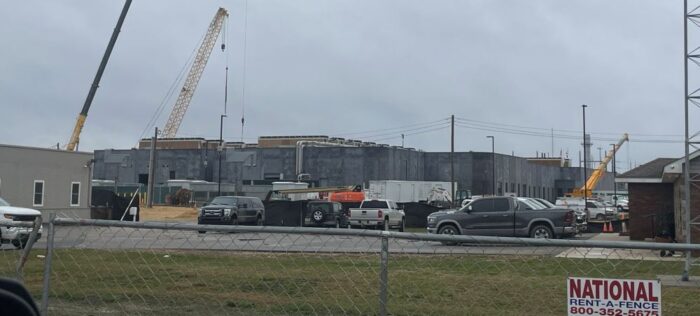
During the video, the mayor referenced a nearby example that has fueled fears among Monroe residents. Although he didn’t name it directly, he appeared to be referring to the city of Vineland, where a project originally approved and built as a golf course ultimately became the site of a massive data center.
That kind of shift is exactly what Monroe residents were worried about: that a warehouse approval could eventually pave the way for a data center.
To address those concerns, the mayor said the township will likely fully remove data centers from the Hexa Redevelopment Plan. If adopted, Monroe would have no areas on its zoning map where data centers are permitted.
Still, the township appears to be stopping short of an outright ban.
Why a Stronger Approach May Be Needed
At Pinelands Alliance, we believe municipalities should move beyond simply discouraging data centers and consider proactively banning them—at least temporarily.
The mayor noted that the township’s legal team is researching a possible ordinance to ban data centers altogether, though he did not sound enthusiastic about the idea. At the time that he had met with staff from Pinelands Alliance and Food & Water Watch, no NJ towns had yet fully banned data centers. The mayor claims “that is for a reason” but does not really explain, implying that this is a conscious decision, rather than simple inaction.
We see a different explanation: data centers are a rapidly emerging issue, and many local governments are still catching up. Residents and advocacy groups have effectively been playing zoning “whack-a-mole” as projects pop up across the state.
A temporary moratorium—say, three years—could give communities time to understand the impacts and plan responsibly.
Pemberton Township decided it was done playing catch-up. This town has been plagued by the warehouse boom of recent years, so residents and elected officials decided to get ahead of the situation this time. On February 20, 2026 Pemberton Township became the first NJ municipality to take proactive action passed ordinance 10-2026 to “prohibit the construction and operation of data centers”.
In North Jersey, Green Township (Sussex County) and Phillipsburg (Warren County) may not be far behind.

A Bigger Question: What Counts as “Redevelopment”?
This debate has also raised a question that residents frequently ask—one that even appeared as the top comment on the mayor’s video: How can you redevelop something that was never developed in the first place?
It’s a fair question, and one that Pinelands Alliance has been raising for years.
Redevelopment laws were originally intended to revitalize abandoned or blighted properties, bringing new life and investment to old development. But in rural South Jersey, the same tools are often used to rezone forests and farmland that have never been built on.
That creates a troubling incentive: developers may target untouched land because it’s easier and cheaper than cleaning up or repurposing already-developed sites.
Efforts to Fix the Law
Pinelands Alliance has been working with legislators in the New Jersey Senate and Assembly to address this issue.
Current state law allows municipalities to designate large areas—including undeveloped land—as areas in need of rehabilitation. Over time, a law designed to address blight has been used to justify clearing forests and wetlands that have never seen a bulldozer.
That’s why we support Senate Bill No. 1857/Assembly Bill No. 177 which would exclude farmland from being designated as redevelopment or rehabilitation areas.
We are also working with the bill’s prime sponsor, Latham Tiver and other interested legislators, to strengthen the legislation further—by ensuring that undisturbed forests are protected as well.
What You Can Do
These outcomes show that public engagement matters. If you want to help prevent similar situations elsewhere, here are a few ways to take action:
- Sign the petition urging the governor to enact a statewide moratorium on new data centers in New Jersey for at least three years.
- Ask your town council to adopt an ordinance explicitly prohibiting data centers as a permitted use in your municipality—like Pemberton Township already did. View a model ordinance here.
- Contact your state legislators and urge them to support Senate Bill No. 1857/Assembly Bill No. 177—and to include protections for forests as well as farmland.
- Attend or call-in to the Pinelands Commission meeting on March 27, 2026 when data centers will be on the agenda for the CMP Policy & Implementation Committee.
Residents showed up, spoke out, and changed the conversation in Monroe and Pemberton townships. Now the question is whether communities across New Jersey will do the same.
