
Last reviewed/updated November 10, 2026
A Tree in Trouble
New Jersey once held roughly 115,000 acres of Atlantic white cedar — dense, shadowy swamp forests found nowhere else in such concentration on the East Coast. Today, less than 30,000 acres remain. The causes read like a list of everything that’s happened to the Pine Barrens over the last two centuries: development and road-building, decades of improper logging, an exploding white-tailed deer population that eats seedlings faster than they can establish, wildfire, altered hydrology, flooding from beaver dams, saltwater intrusion, theft, and natural succession to other tree species once cedar stands are disturbed. Humans have tipped the scales in favor of the deer, beaver, and saltwater intrusion that have been killing cedar and preventing their regeneration.
That last item is the crux of the problem. Atlantic white cedar doesn’t come back on its own once it’s cut or damaged. Left alone, a disturbed cedar swamp typically converts to red maple, sweetgum, and other hardwoods. Tree species that deer find less appetizing get the upper hand to outcompete cedar seedlings for light and space, so passive conservation doesn’t work here. Something has to actively intervene to give cedar a fighting chance, which is why the state has had the goal of restoring it for decades.
The NJ Department of Environmental Protection has been gearing up to work on a formal 10-year, 10,000-acre commitment that it made in 2021. Pinelands Alliance supports this goal. However, we are concerned with the specific mechanics that could sacrifice the ecological health of the whole system to maximize productivity of a single species.
What DEP Has Proposed at Wharton
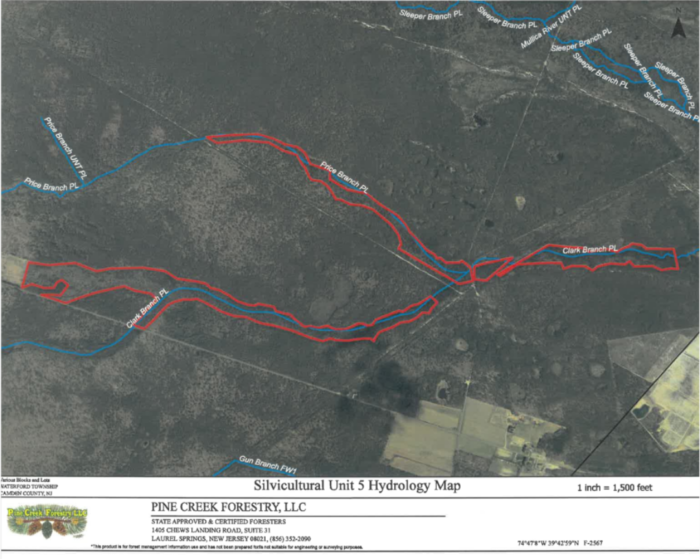
NJDEP Forest Service filed Application No. 1994-0288.002 with the Pinelands Commission, proposing forest management and cedar regeneration on 171 acres of the 6,761-acre Wharton State Forest tract in Waterford Township. The plan runs for the CMP’s standard 10-year forestry permit period and includes:
- Selective harvest with cedar retention across the site. All viable mature cedar identified as a seed source is to remain standing.
- Site preparation through mowing, drum chopping, and disking, plus up to 15 temporary log landing areas.
- Herbicide use, via aerial broadcast and targeted spot treatment of imazapyr salts, with glyphosate available for spot treatment, applied in late summer when cedar needles have hardened off. Up to three herbicide treatments are permitted over the 10-year period.
- Conditional deer fencing. If annual monitoring shows fewer than 800 cedar seedlings per acre — the threshold the plan treats as regeneration failure — the applicant will replant at 1,000 seedlings per acre and install a 6-foot mesh deer fence around the project perimeter. This can be repeated up to three times over the permit period.
The process by which the plan was reviewed and approved leaves much to be desired, as we explained in a blog post.
- Why were large swaths of mature cedar forest included in the project area? When Pinelands Commissioners pressed the applicants on this question, DEP staff refused to acknowledge that much of the acreage is not in need of restoration.
- There is a significant gap between the “worst case” scenario of the written permit and what was verbally explained by DEP staff. The public was allowed to comment on the written permit but not the latter.
- Questions from Pinelands Commissioners were suppressed by Pinelands Commission staff.
- The public was not given sufficient opportunity to comment on the application, particularly, all of the new information that was introduced via verbal presentation to the Pinelands Commission on 10/9: the day of the vote when the record had already been closed.
Given the significant gap between the written permit and the DEP’s actual intent, Pinelands Alliance has made our expectations for the project public through a petition. We will also be monitoring the progression of the work on-the-ground.
To improve the process for next time, we are asking the Pinelands Commission:
- That DEP staff be allowed to give a presentation about significant applications well in advance of a vote.
- The scope of forestry permits should be constrained so we are not approving “worst case” scenarios—we should not be giving out blank checks for ecological destruction just because Pinelands Commission staff want to avoid potentially doing extra paperwork.
- Amend the Pinelands CMP to require a more strict review of forestry applications proposing habitat conversion, including a dedicated public hearing.
Timeline
The long decline
- Pre-colonial era: ~500,000 acres of Atlantic white cedar along the East Coast; New Jersey alone held roughly 115,000–125,000 acres, concentrated in the Pine Barrens.
- 1870–1890: The advent of steam-powered logging and dredging equipment opens up previously inaccessible cedar swamps to industrial harvest. An estimated 50% of all existing white cedar acreage in the state is cut in this 20-year window.
- 1900: New Jersey’s cedar acreage has fallen to roughly 52,500 acres — less than half its pre-industrial extent.
- 20th century, ongoing: Deer populations expand dramatically, and browse pressure becomes a chronic obstacle to natural regeneration — cut cedar stands increasingly convert to maple, gum, and pine rather than regrowing as cedar.
The modern restoration push
- 1995: NJ Forest Service forms the Atlantic White Cedar Initiative steering committee to coordinate cedar management and research statewide.
- 2007–2012: A Northeast Corridor grant funds cedar restoration at Double Trouble State Park, one of the first large post-2000 efforts.
- 2021: NJDEP announces a 10-year, 10,000-acre Atlantic White Cedar Restoration Project — the largest cedar restoration effort ever undertaken in the country — with Wharton identified as a priority site given its extensive existing cedar swamps.
- 2026: Application No. 1994-0288.002 submitted to the Pinelands Commission. Pinelands Alliance submitted comments to the Pinelands Commission criticizing the plan’s use of herbicides, potential impact on threatened and endangered species, clear-cutting practices, and relative lack of deer management.
- October 9, 2026: The Pinelands Commission finally has the chance to ask DEP staff questions directly after the record has already closed (read about the debate on our blog) and votes to approve the plan by a vote of 11 to 2.
Take Action
- Sign the petition to show your support and receive updates on this issue.
- Come to the Pinelands Commission Meeting and express your disappointment in the handling of this application:
Date: Friday, November 13th at 9:30 AM
Location: Pinelands Commission Meeting, in-person (15 Springfield Road New Lisbon, NJ 08064) or live-streamed on YouTube.
