Mighty Pines by Becky Newcomb
Policy Notes: May 2026
Shamong residents push back on Burlington County plans, updates on tree clearing in Franklin Township, and are towns planning for affordable housing in the Pinelands? Policy Notes are designed to update the public on the activities of the Pinelands Commission, which have been summarized by Pinelands Alliance staff who attend all public meetings of the Commission.
Roundabout Solution in Search of a Problem
Shamong Residents Push Back on Burlington County’s Stokes & Willow Grove Plan
The May meeting of the Pinelands Commission drew an unusually large crowd—both in person and online—as Shamong Township residents, local officials, and concerned observers voiced strong opposition to Burlington County’s proposal to replace the stop-controlled intersection at Stokes Road (CR 541) and Willow Grove Road with a modern single-lane roundabout.
County officials describe the project as a safety improvement intended to reduce crashes, slow speeds, and improve traffic flow at what they characterize as a hazardous rural intersection. But for many residents, the bigger question was simple:
What problem is this roundabout actually solving?
One of the most persistent criticisms was that the county appears to be relying on a traffic study from 2003—a very different era for this corner of Shamong.
Back then, the nearby Atco Speedway was still operating, drawing large crowds and significantly affecting regional traffic patterns. With the speedway now closed, residents argue that today’s traffic volumes no longer justify a major redesign. As one nearby resident bluntly told commissioners: “Traffic cut down in half.”
For opponents, this raises concerns that Burlington County may be planning for congestion that no longer exists, while ignoring the dramatically changed reality on the ground.
Environmental Concerns in the Pinelands
Although the Pinelands Commission does not evaluate traffic engineering itself, residents emphasized that infrastructure decisions can still carry significant environmental consequences. Roundabouts can reduce vehicle idling and emissions over time, but most of these benefits can also be achieved with widespread adoption of electric vehicles.
Construction impacts in an environmentally sensitive area may outweigh these benefits, as a roundabout would require a larger land footprint than simpler safety upgrades, tree clearing, and loss of roadside vegetation. In the Pinelands, where ecological fragmentation can have outsized consequences, these land-use impacts matter.
Why Not Try Smaller Fixes First?
A point that appeared to resonate strongly was the apparent lack of effort to pursue lower-cost, lower-impact alternatives before proposing a full roundabout.
Residents repeatedly asked why Burlington County had not first considered measures such as rumble strips, flashing beacons, and speed bumps. These options could potentially address speeding and safety concerns without the environmental footprint or price tag of a full-scale redesign. For many attendees, skipping directly to a roundabout felt less like thoughtful planning and more like overreach.
Cost, Priorities, and Public Trust
Opposition also reflected broader frustration about county spending priorities. At a time when residents are hearing about budget pressures affecting schools, EMS, and other essential services, some questioned whether this is the best use of taxpayer dollars. Republican Burlington County commissioner candidate Joe Abegg reportedly described the project as “mindless spending,” echoing concerns that county government may be pursuing expensive infrastructure without adequately demonstrating need.
Others pointed to intersections elsewhere in Burlington County—such as locations in Chesterfield where residents have actively requested roundabouts—that they believe deserve more urgent attention. As residents repeatedly voiced concerns about outdated studies, ignored alternatives, environmental disturbance, and local opposition, some openly questioned whether political favoritism or insider interests could be influencing the process.
How much sprawl can we afford?
As New Jersey municipalities scramble to finalize plans for meeting their next round of affordable housing obligations, a deeper question is emerging across the Pinelands: Are towns genuinely planning for affordable housing—or using state mandates to justify oversized market-rate sprawl?
The Pinelands Commission has spent recent months reviewing municipal affordable housing ordinances to ensure compliance with the Comprehensive Management Plan (CMP), and in some cases, that review is exposing a troubling pattern. In Jackson Township, for example, officials argued that Pinelands protections left them with no choice but to dramatically upzone land in the Pinelands to satisfy their Round 4 obligations. Yet the numbers tell a different story.
Only about half of Jackson township is in the Pinelands, and the other half is not. The town must provide roughly 1,000 affordable units, but it has proposed to place the majority of these units (581) in the Pinelands half of town. This alone would not be a problem—in fact, the Pinelands properties that the town has targeted could accommodate all 1,000 affordable units. The problem is the way that a much larger number of market-rate units has inflated the size of the development. Jackson Township was trying to cram 3,000 total units, which is roughly triple the zoning capacity that the Pinelands Commission would actually allow. This suggests that the real driver may not be affordable housing itself, but the market-rate development attached to it.
This dynamic reflects a widespread misconception in New Jersey housing policy: that affordable housing must come primarily through large inclusionary developments where only about 20 percent of units are affordable while the remaining 80 percent are market-rate. In reality, the 20 percent set-aside was designed as a minimum threshold, not a hard cap. Yet many municipalities have effectively treated it as a ceiling, codifying low affordability percentages into local ordinances and thereby creating developments far larger than necessary to meet legal obligations.

Medford Township illustrates this same tension. To satisfy a need for just 171 affordable units, the township has advanced plans that could yield nearly 1,000 total homes. Residents concerned about preserving Medford’s rural character have focused largely on opposing development altogether, but there is another path: build the affordable units more directly, reduce the market-rate excess, and dramatically shrink the project footprint. Whether through 100 percent affordable developments, rehabilitation, or simply requiring higher affordable set-asides, towns often have more flexibility than they claim.
Examples elsewhere prove this is not theoretical. Sparta has approved projects with roughly 45 percent affordability, and many municipalities across New Jersey support fully affordable developments. The idea that only sprawling 20 percent inclusionary projects are financially feasible often benefits developers more than communities or housing access.
The Pinelands Commission itself may unintentionally reinforce this pattern through its Pinelands Development Credit (PDC) exemption for affordable housing. Affordable units are exempt from purchasing costly PDCs—a potentially major financial advantage, especially when PDC prices can exceed $23,000 per quarter-credit. However, municipalities control how broadly this exemption is applied, and many local ordinances still structure it around the familiar 20 percent model. In places like Monroe Township, exemptions are often capped in ways that can make partially affordable projects more financially attractive than 100 percent affordable ones, even though the latter could reduce environmental impacts.
Monroe also highlights a better alternative: leveraging municipal affordable housing trust funds. These funds, supported by development fees and available in many New Jersey municipalities, can finance rehabilitation, gap subsidies for fully affordable housing, land acquisition, and other housing strategies that do not depend on large-scale market-rate expansion. At the April 24 meeting of the Pinelands CMP Policy & Implementation Committee, a Monroe township representative described how the town has used its trust fund not only for rehabilitation but also to consider supporting fully affordable projects when tax credits fall short. This model offers a powerful reminder that towns are not limited to the developer-driven inclusionary framework.
Across New Jersey, many municipalities have these trust funds—but too often under utilize them, relying instead on conventional large-scale inclusionary projects. That choice can mean more greenfield development, more environmental pressure, and more public backlash than necessary.
Affordable housing is essential to New Jersey’s future, and the Pinelands should not be used as an excuse to avoid it. But neither should affordable housing become a political shield for excessive sprawl. The tools already exist—higher affordability percentages, municipal trust funds, rehabilitation programs, and direct subsidies—to meet housing obligations while minimizing environmental damage.
The real challenge is not whether New Jersey can build affordable housing without sacrificing the Pinelands. It is whether local governments are willing to prioritize housing need over developer convenience.
Update: Clearing in Franklin Township
In June of 2025, we notified Franklin Township and the Pinelands Commission of approximately 15 acres of forested wetlands that was being cleared. Since this time, the damage has expanded to approximately 45 acres. Read more in one of our recent blog posts.
At the center of the controversy is the owner’s (Tim Doyle) apparent attempt to rely on one of the CMP’s narrow agricultural exceptions: the conversion of certain wetlands for blueberry or cranberry agriculture. While berry horticulture can under specific conditions qualify for exceptions, we argue that this does not excuse bypassing environmental oversight, especially at this scale.
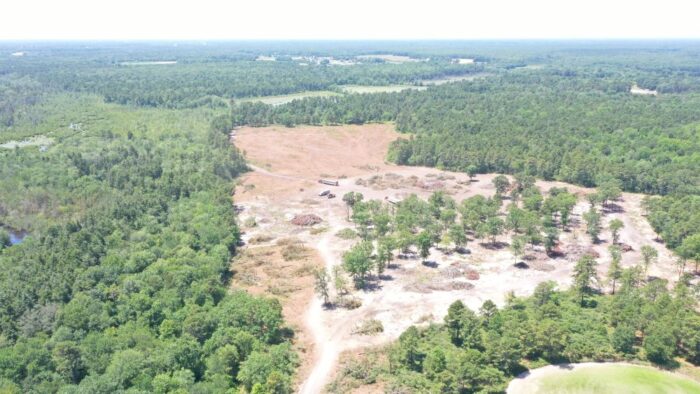
The core issue is not simply whether berry agriculture is technically allowed—it is whether a township official can clear first and seek regulatory cover later. Normally, significant land clearing in sensitive Pinelands environments should be reviewed in advance so regulators can:
- Evaluate wetlands impacts
- Identify threatened or endangered species
- Recommend avoidance or mitigation measures
- Ensure compliance with local and Pinelands standards
Because the clearing occurred before full environmental review, opponents argue that the ecological baseline may now be permanently lost.
Why environmental review matters
Once a wetlands forest is cleared, the damage extends far beyond the loss of trees alone. Critical habitat for wildlife may be destroyed, rare or sensitive plant communities can be permanently altered, and the site’s natural hydrology—the delicate movement and storage of water that defines wetland ecosystems—may be disrupted in ways that are difficult or impossible to reverse. Just as importantly, the ecological evidence needed to understand what species, functions, or conservation values existed there before disturbance may vanish with the landscape itself. In many cases, once the clearing has occurred, the opportunity to fully assess what was lost is gone.
Why Doyle’s role intensifies scrutiny
Doyle is not just a private landowner—he is Franklin Township’s deputy mayor, part of the local government structure charged with enforcing Pinelands protections through township ordinances. That has fueled criticism that those entrusted with enforcing the rules should be especially accountable when their own actions trigger possible violations.
Complicating matters further, the property is reportedly subject to a 1990 Pinelands Development Credit (PDC) deed restriction (as described on Page 15 of the Pinelands Commission Monthly Management Report), which explicitly grants the Pinelands Commission inspection rights to ensure compliance.
For the wetlands that remain and for the species we can no longer assess, the Pinelands Commission must hold the line of accountability for this violation.
Months since the Pinelands Municipal Council Last Met: 43
