Open Pines of Bass River by David Seals
Policy Notes - February 2026
Time to re-examine enduro racing policies and Jackson Township affordable housing plan. Policy Notes are designed to update the public on the activities of the Pinelands Commission, which have been summarized by Pinelands Alliance staff who attend all public meetings of the Commission.
How much can the Pinelands endure? Insights from the annual science update.
When can enduro racing events be held in the Pinelands? How much distance needs to be maintained between development and wetlands? When can prescribed burns be performed to maintain healthy pine barrens ecosystems? All of these questions are informed by research done by the Pinelands Commission’s science staff.
At the February meeting of the Pinelands Commission, John Bunnell and his team presented ongoing research on rare and iconic Pinelands species, as well as groundwater monitoring efforts. (The full presentation is available on the Commission’s YouTube channel.) Much of the update focused on snake and turtle hibernation pattern research that has value as basic research for understanding the life cycles of iconic pine barrens species, but also informs important regulatory decisions made by the Pinelands Commission.
So what do the sleeping habits of reptiles have to do with cross-country motorcycles? The Pinelands Commission regulates enduro motorbike events in the Pinelands, of which there are at least a dozen that occur every year—including enduro races, dual-sport rides, and hare scrambles. Event planners work with the Pinelands Commission to plan race routes and timing, limiting when they occur to periods when snakes are believed to be safely hibernating underground.
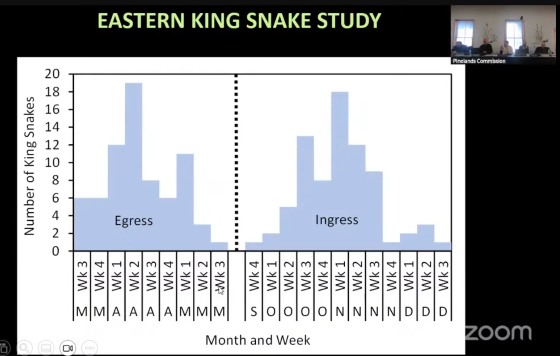
The challenge? The open sandy areas preferred by riders are often the same areas snakes use for overwintering. If timing is off, snakes can be killed. Current permitted windows for enduro events are based on historic assumptions about when snakes enter and exit hibernation: October 15 to April 15. But new data suggest the majority of snakes may not yet have reached their hibernacula by the start of the permitted window—and many may emerge earlier than previously believed.
Is this policy mismatch due to incomplete data, or shifting seasonal patterns?
Research presented at Pinelands Alliance’s 2025 Science Forum suggests climate change is making hibernation timing increasingly unpredictable. That unpredictability complicates regulation and makes it harder to prevent both accidental harm and poaching.
Commissioner Lohbauer took a deep dive into the topic of Enduro regulations back in 2023 (summarized on our blog), and asked whether it may be time to revisit the Commission’s practices. When asked which months would be safe for enduro events, Bunnell declined to name any specific window. His response was simple: “The best thing to do would be to stay out of areas where there’s snake hibernacula.”
We at Pinelands Alliance agree with these sentiments—and we believe it is time to seriously examine whether this type of motorized activity is compatible with conservation goals on public lands in the Pinelands.
Other Findings from the Science Team
- New Methods for Studying Hibernation: How do scientists actually know when snakes and turtles are hibernating underground? The team is using an elegantly simple tool to answer this question using new methods: small temperature loggers known as iButtons. By attaching them to animals and placing others above and below ground, researchers can determine the exact day an animal emerges from hibernation—when its body temperature shifts from matching underground temperatures to surface temperatures.
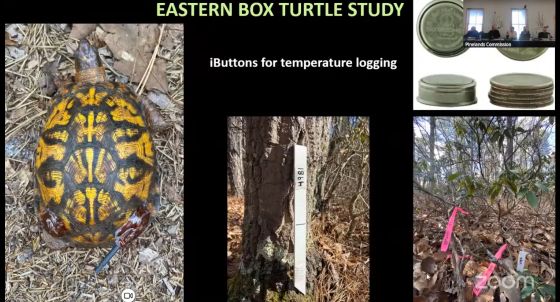
- Prescribed Burning: The same approach helps guide prescribed burn timing for eastern box turtles, which hibernate in shallow depressions under leaf litter. Because turtles move slowly and overwinter close to the surface, they are particularly vulnerable to burns that occur at the wrong time.
- Wetlands Buffers: Long-term tracking studies are also reinforcing existing policy. Research on king snakes shows that roughly 85 percent of their time is spent within 300 feet of wetlands. That finding provides scientific backing for the Commission’s long-standing requirement of a 300-foot development buffer around wetlands. Those lines on a zoning map are not arbitrary—they reflect real habitat use patterns.
- Snake Fungal Disease: The threats to Pinelands species don’t end with motorbike traffic. Snake fungal disease is spreading across eastern North America, and infection severity appears to increase moving northward—likely because longer hibernation periods allow the fungus to persist and reinfect snakes in their dens. Timber rattlesnakes are among the hardest hit species. In response, the science team is launching an ambitious “head-start” program: collecting gravid (a.k.a. pregnant) rattlesnake females, raising hatchlings in controlled conditions, and releasing them back into the wild to improve survival rates.
- Rising Salt Levels: The team is also preparing long-awaited groundwater monitoring data, including tracking rising salt concentrations in Pinelands waters. Increased road salt use is showing up in streams and ponds across the U.S.. Bunnell added, anecdotally: “Look how much road salt is out here now, thirty years ago we didn’t put that much salt down—anywhere. They used to put sand and cinders—now it’s all salt.” Hard data on salt levels could guide smarter policies, such as adjusting application frequency, reducing quantities, or switching products. For example, magnesium chloride is generally less harmful and more effective than sodium chloride in sensitive environments.
The science tells us what is at stake. Holding the line in the Pinelands—whether through wetland buffers, careful event scheduling, or resisting unnecessary overdevelopment—is not about obstruction. It is about aligning our decisions with what the data clearly show. And the data, year after year, tell the same story: this landscape is both resilient and fragile. Protecting it requires discipline, humility, and a willingness to let science guide the way.
Jackson Can’t Afford to Follow the Pinelands Plan?
At a recent meeting of the New Jersey Pinelands Commission, staff planner Brad Lanute laid out concerns about Jackson Township’s proposed housing plans. You can watch the breakdown on their YouTube channel.
Jackson leaders say Pinelands regulations make it impossible to meet the state’s affordable housing requirements. About half the township sits within the Pinelands, and officials argue that building there is their only realistic option for growth.
But that argument depends on a common misunderstanding.
Many towns assume affordable housing can only happen through large developments where 20 percent of the homes are affordable and 80 percent are market-rate. Some, including Jackson, have written that 20 percent figure directly into their local laws. Yet that number was meant to be a minimum, not a maximum.
Jackson’s current obligation is 1,000 affordable homes. Officials propose placing 581 of them in the Pinelands. The land they’ve identified could support about 1,001 total homes under existing zoning—meaning projects close to 50 percent affordable could meet the need without changing the rules. Instead, Jackson is proposing more than 3,000 units—triple what’s currently allowed. Affordable housing is vital, but it shouldn’t be used to justify overdevelopment in one of New Jersey’s most environmentally sensitive regions. Since then, Commission staff have met with township officials and extended the review deadline to May so Jackson can reconsider its approach.

Months since the Pinelands Municipal Council Last Met: 40
