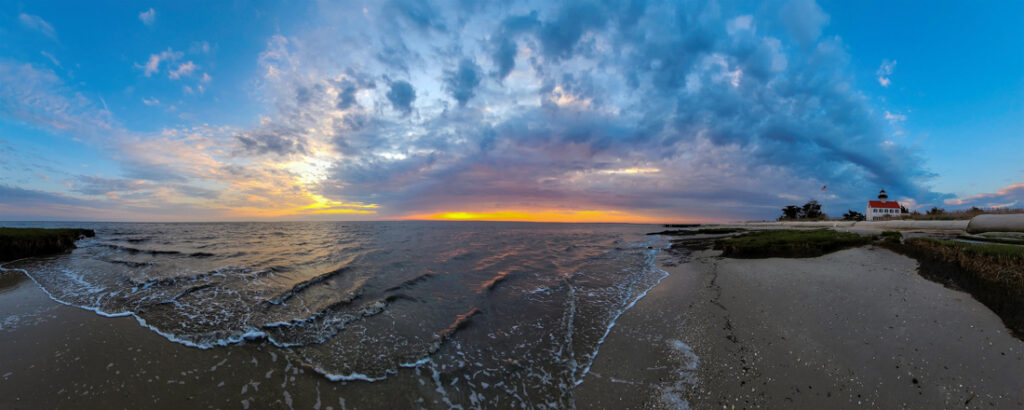
East Point Stormy Skies Panorama by Susan Rogozinski
NJ Flood Protection Rules Adopted
Advocates Say NJPACT REAL Rules will Save Lives and Protect Properties
New Jersey is the first and only State to adopt proactive land use regulations that are safer from flooding and are more resilient to the increasing impacts of climate change. The New Jersey Protecting Against Climate Threat Resilient Environments and Landscapes (NJPACT REAL) were adopted this week upon publication in the New Jersey Register. The NJPACT REAL rules are based on groundbreaking climate change impact modeling science and require new development to be built above sea-level rise as projected for the year 2100.
The NJPACT REAL land resource protection rules “better support New Jersey communities, residents, and businesses in building their resilience to sea-level rise, extreme weather, chronic flooding, and other impacts of our changing climate. Almost two-thirds of New Jersey’s coastline is already at high or very high risk to coastal erosion and 98% of the coastline is projected at medium or very high risk to sea level rise. Over half a million acres of New Jersey land are highly vulnerable to coastal hazards,” according to the New Jersey Department of Environmental Protection (NJDEP).
“Today’s action is a bold move to align New Jersey’s land use rules with the realities of climate change and an important complement to the Inland Flood Protection Rule adopted by NJDEP two and a half years ago. Climate change is already knocking at our doors, flooding our streets, and threatening the places we call home. Too many New Jersey families are living with the fear that the next storm could be the one that takes their homes, their livelihoods, or worse,” Jim Waltman, Executive Director, The Watershed Institute. “By planning for higher seas and more intense storms, these rules will save lives, reduce costly damages, and safeguard the natural systems that make our state more resilient. We applaud Governor Murphy, Commissioner Shawn LaTourette, and the New Jersey Department of Environmental Protection for the bold, forward-looking leadership New Jersey needs to meet the climate crisis head on. We look forward to working with Governor Sherill to ensure that these rules are implemented with the urgency that this crisis demands.”
“The NJPACT REAL rules will save lives and protect properties. The NJPACT REAL rules are science-based policies that require new development to adapt to increased sea level rise flooding.” Jennifer M. Coffey, Executive Director of the Association of New Jersey Environmental Commissions (ANJEC). “The rule proposal was, however, weakened at the behest of developers in July 2025, and it now includes a provision to allow for affordable housing to be built in flood prone areas. It’s immoral to construct housing for the most economically vulnerable New Jerseyans in the highest risk areas. We urge Governor Sherrill to both implement the NJPACT REAL regulations to prioritize the proposal of flood policies that protects all New Jesey residents regardless of the amount of their paychecks.”
In addition to adopting building elevation requirements for new residential development, the NJPACT real rules include new stormwater management requirements for redevelopment projects previously exempt; new nature-based solutions permitting designed to accelerate restoration projects; and additional protections for wetlands.
“The NJPACT REAL rules — the first science-based resiliency regulations in the country — will help preserve and protect the delicate ecosystem within the one million acres of the Pinelands, said Michael Klein Director of Government Relations Pinelands Alliance. “Of paramount importance is the 17-trillion-gallon Kirkwood-Cohansey aquifer underlying the Pinelands, which provides drinking water for about one million people and irrigation for 200,000 acres of farmland. Flooding threatens the quality of this vital water supply. In addition, rising sea water and storm surges are forcing saltwater upstream into the Pinelands’ forests, killing trees at the root and creating “ghost forests”: extensive stands of dead trees inside the Pinelands. The long-awaited adoption of the REAL rules will help save all these precious resources.”
Many of the roads and buildings in service today on New Jersey’s coast will be likely unusable by the year 2100 given the increasing flooding impacts of sea level rise. New Jersey is one of the states most impacted by climate change with the fastest increase in warming temperatures and the third highest number of flood insurance claims in the nation. From 1980–2024 (as of September 10, 2024), there have been 72 confirmed weather/climate disaster events with losses exceeding $1 billion each to affect New Jersey, according to the National Center for Environmental Information. On average, New Jersey experiences a $1Billion weather event every 32 weeks.
“New Jersey’s shore is part of who we are—but every storm and flood makes it painfully clear how exposed our communities are as the climate crisis accelerates. After years of hard work and advocacy, we’re thrilled to see the NJPACT Coastal rules finally adopted. This is bold, science-based leadership, and we applaud Governor Murphy and the NJDEP for stepping up to protect lives, homes, public safety, and our economy. This decision puts New Jersey on a stronger, safer path and will safeguard our communities for generations to come.” Allison McLeod, Acting Executive Director, New Jersey LCV
“The Sierra Club thanks Commissioner LaTourette and Governor Murphy for finally adopting this lifesaving package of rules that NJ urgently needs,” said Anjuli Ramos New Jersey Sierra Club Executive Director. “With the rules now in place, we can finally move from delay to implementation and action, getting the REAL work done to protect both lives and property while making communities more resilient and prepared for the next storm. We look forward to working with the Mikie Sherrill Administration to ensure these protections are effectively and fully implemented.”
“It’s clear our climate is changing and we are living in a wetter and wilder world. Sadly, we have too many examples in New Jersey of coastal flooding devastating communities. Our land use rules need to reflect this new reality – especially in our coastal communities along the Shore and beyond which are uniquely vulnerable to sea level rise. Six years ago, Gov. Murphy pledged action on NJPACT rules — it is fitting that one of his last acts in office was fulfilling that commitment. We look forward to working with Gov. Sherrill to ensure these rules are implemented and acknowledging that we shouldn’t wait for the flood waters to be at our door before we act,” said Doug O’Malley, Director of Environment New Jersey
“Passing the NJ PACT REAL rules today helps New Jersey reduce future damage and the costly cycle of repeated repairs, tomorrow. By updating flood and stormwater standards to reflect real climate risks, these rules give the Sherrill administration a strong opportunity to turn science-backed policy into safer communities and lower long-term costs,” Danielle McCulloch, American Littoral Society.
