Policy Notes - Summer Wrap-Up
From trash juice pipelines to data center lawsuits—the Pinelands Commission covered a lot of ground this summer!
I love a good to-do list—and apparently so does the Pinelands Commission! They dedicated most of the 7/31 meeting of the P&I committee to reflect on their progress from the previous year and outlined plans for the fiscal year that recently started. See the full list on their website (Slides 39-64) or the recording on their YouTube channel.
Grading the To-Do List
Pinelands Alliance staff commended the Commission on real progress, including accessible trails and the Black Run Preserve. Commission staff deserve special kudos for absorbing the unexpected workload that data center applications and bans have created, and for holding their ground on affordable housing with Jackson Township.
We also had notes:
Artificial turf. The Green Acres bill gaining bipartisan momentum in both houses of the Legislature won’t address many of the underlying issues (read our op-ed here). We still recommend that the Commission hear from natural grass experts, such as sports field managers, on why artificial turf fields are unnecessary to meet the recreational needs of South Jersey communities. Given all of its environmental problems, artificial turf should no longer be treated like a necessary evil to be tolerated—especially in an environmentally-sensitive region lie the Pinelands.
The protected plant list. We’re glad it’s still on the agenda, but we offered a correction to the framing. This is less an “expansion” than an update to bring the list in line with current science. Some species will be added and some removed to reflect their real-world status. The point is to spend investigative energy where it matters most, rather than defend an outdated and occasionally inaccurate list for the sake of appearances.
Road salt. This one wasn’t on the list at all. Salt applied to roads in sensitive areas faces no restrictions, even though the application of, say, herbicides in the same places would be scrutinized. Sand and gentler de-icing alternatives are widely available.
Climate change. It still isn’t addressed by name in the Pinelands Comprehensive Management Plan (CMP). Naming it is a first step toward addressing how it touches every other protection in the document.
Tree removal. This is the issue that looms largest and remains unaddressed. It’s what residents most often contact us about, usually after noticing a neighbor removing an alarming number of trees while their town administration does little to stop it. This year we saw the enormous loopholes the CMP makes for agriculture in Franklin Township, and we’re watching overly aggressive forestry planned for Wharton State Forest. Most of the land in the Pinelands is preserved, in public and private hands alike. But what good are those protections if the trees themselves aren’t protected?
Thirteen Steps to a Yes (Give or Take a Year)
At its August 14 meeting, the Commission reviewed its history with a tool most residents have never heard of: the Memorandum of Agreement, or MOA.
Think of an MOA as a custom-built solution for problems the CMP didn’t anticipate. The CMP is the rulebook, but no rulebook covers everything. Sometimes it’s silent or ambiguous, and sometimes a compelling public need requires an agency to find a workable path forward. An MOA is the negotiated agreement that fills that gap.
The Commission adopted this process in 2008 and revised it in 2016, and it now runs 13 steps. It is long and complicated on purpose, because it builds in deliberation and public input. In total it typically takes about a year, largely because of the lead times required for public notice and comment.
That’s a reasonable price for a genuinely novel problem. It’s a less reasonable price for a problem that isn’t novel anymore. Accessible trails have gotten stuck in this loop even though the issues are well defined and the approach can largely be replicated. That’s why Pinelands Alliance has been advocating for CMP revisions that would address accessible trails directly and spare future projects the bureaucratic headache.
Commission legal counsel Stacey Roth walked through the history of past MOAs, including agreements involving the Atlantic City and Ocean County airports, the Stafford Landfill and Business Park, and the Ancora psychiatric facility. The issues ranged from habitat replacement for new electric transmission lines to sewage treatment to threatened and endangered species, the golden aster in particular.

And the MOAs keep coming. The Black Run Preserve MOA for an accessible trail has hit roadbumps because the town has had to address other violations along the way. The South Jersey Transportation Authority is in early discussions with the Commission about bringing freight in to warehouses. And the Cape May County Municipal Utilities Authority (CMCMUA) has one in progress, which brings us to trash juice.
The Woodbine Landfill and Its “Trash Juice”
Did you know there is only one landfill still operating in the Pinelands? It’s in Woodbine, and it takes in the county’s trash. Every community produces waste, and someone has to manage it responsibly. But the story doesn’t end once our waste is locked away under layers of dirt and plastic. Things decompose in there, and decomposition produces leachate, which I like to call “trash juice.” Woodbine generates about 49,000 gallons of it per day. It has to be collected and treated like any other wastewater, except that it is a far more potent cocktail. Compared to domestic sewage, landfill leachate typically has about five times the biological oxygen demand (a measure of how much oxygen microbes will gulp down while breaking it down) and 20 to 25 times the ammonia.
Treating leachate onsite isn’t an option, so Woodbine trucks it to the Middle Wastewater Treatment Facility at Seven Mile Beach where it can be handled properly. That costs real money and real emissions: roughly 68,000 miles a year in diesel trucks. With an estimated 130 years of remaining landfill capacity, plus another 30 years of leachate treatment after that, whatever solution gets chosen will be with us for a very long time.
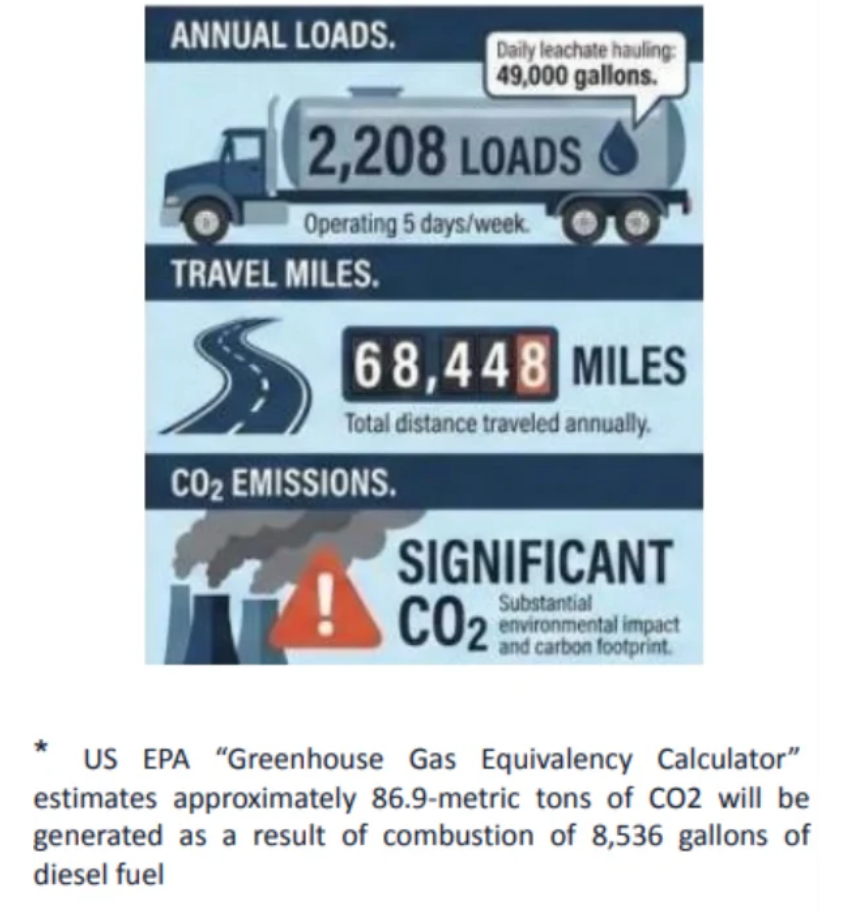
The CMCMUA has a plan to end the trucking, and its representatives presented an outline to Commission staff at the July P&I meeting. The plan is to build a pipeline.
Why this needs an MOA instead of a standard application
The short answer is water. Trucking leachate to Cape May already moves water between drainage basins, and the pipeline would do the same. The pipeline design would also serve Woodbine properties that are currently on outdated septic systems and cesspools, a real benefit for those homes. That sewage would mix with the leachate on the way to Cape May, where the combined flow would be treated together.
To see why this is a big deal, you need to know something about how the Pinelands treats wastewater. Septic systems are mandated in many parts of the region. That limits the scale of development possible on a given lot, and it also keeps local hydrology intact by returning water close to where it was pulled from the aquifer. It’s why the Commission is often reluctant to approve extensions of water mains and sewer lines to serve new development. Some developers have pushed the limits of what a septic system can handle with advanced technology, as with what might become the saving grace of Sweet Amalia restaurant. But the premise is the same: water should cycle locally to sustain the aquifer. Exporting it in a pipe is a departure from that premise, which is exactly the kind of thing an MOA exists to evaluate, and it’s the right vehicle for a project like this one.
What was refreshing about the presentation
The CMCMUA presented the alternatives it had considered, something noticeably absent from other major proposals we’ve seen at the Commission lately. Commissioner Lohbauer asked whether electrifying the truck fleet had been considered. It had, and it was eliminated because heavier electric trucks carry smaller loads, which would mean more trips and more wear on the roads.
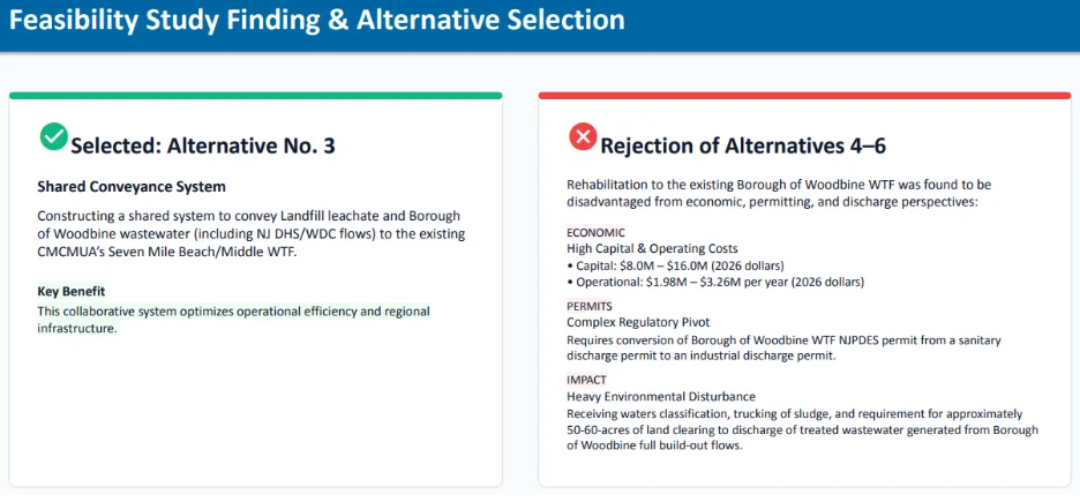
The pipeline would need to cross a 207-foot stretch of Pinelands forest area and 218 feet of a Pinelands town. That is a very different animal from the natural gas pipeline battles of the past decade. It would serve the Pinelands area rather than simply pass through it, which is what the CMP requires. It would also be built by trenching along road rights-of-way that are already approved, avoiding the complications of horizontal directional drilling.
The Ladder Hexa Builders Climbed (and Fell Off)
If the MOA is a process most people never encounter, the next story is a tour of one most people hope to avoid: administrative appeals. At the meeting, Commission Chief of Legal & Legislative Affairs Stacey Roth said, “In my thirty some years that I’ve been practicing, I have never seen a request of or interlocutory appeal of an agency staff decision, and then the amount of briefing that has gone on.”
Here’s the backstory. Hexa Builders had a Certificate of Filing (basically the ticket that says your application is complete enough to start being reviewed) for two warehouses on a parcel in Monroe Township’s Regional Growth Area. It then decided it would rather build a 1,000,000-square-foot data center and a 500,000-square-foot warehouse. Commission staff said that a different project needs an amended Certificate of Filing. Hexa submitted the application and the $5,000 fee, and then asked for an administrative appeal of the very requirement it had just complied with. That request was denied, because the CMP doesn’t give anyone the right to appeal a determination that an application must be submitted.
Hexa is suing the town and has also taken on the Commission, so let’s walk through the rungs of the ladder:
- The Commission’s own appeal process. Denied, because the CMP doesn’t offer one for this kind of determination.
- The Office of Administrative Law (OAL). This is where you’d normally take a beef about how a state agency followed its own procedures, but only if the rules give you a hearing right. Certificates of filing aren’t among the things the CMP affords an OAL hearing for. Denied.
- The Appellate Division. Hexa filed here at the end of June. The court’s case manager then asked a pointed question: was there a final agency action to review?
Why does it matter whether the court was considering a final decision or not? Courts generally review an agency’s last word, not its opinions in the middle of a process. A staff determination that you need to file more paperwork is a step along the way. The court asked both sides to explain by letter whether it was final. Hexa filed its letter on July 14, along with a motion for leave to file an interlocutory appeal, meaning an appeal taken mid-case, before the process is finished, which courts allow only in limited circumstances. The Commission answered with its finality letter on July 22 and its opposition brief on August 7.
On August 31, the Court issued two decisions. It denied Hexa’s motion for leave to file an interlocutory appeal, and it denied Hexa’s motion to file a reply to the Commission’s July 22 letter. So for now, the ladder ends where the Commission said it did: with an amended application to submit and review.
Months since the Pinelands Municipal Council Last Met: 47
