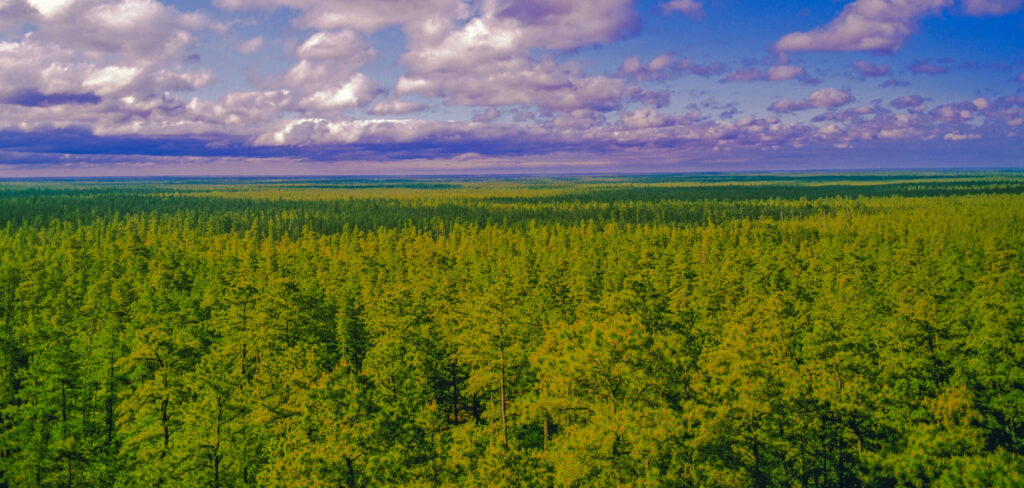
New Jersey Pine Barrens seen from Apple Pie Hill, Wharton State Forest. One of the largest natural areas on the east coast.
Federal and State Forests and Parks Need Stronger Public Support
At the federal and state levels, protections of public forests and parks are fraying. It’s important for the public to remain vigilant and hold public officials accountable to preserve our public lands and provide essential resources to ensure their value as places of recreation, scientific research, and conservation.
Evisceration of the United States Forest Service
On March 31, the Trump administration announced changes to— “really, a gutting of,” according to environmentalist and writer Bill McKibben —the United States Forest Service (USFS). The USFS plans to:
- shut 57 of its 77 research facilities in 31 states.
- close all of its nine regional offices, which manage 154 national forests, and transition to a “state-based model” with two major components:
- 15 state offices (you can see a map of them here). New Jersey will be one of 13 states within the Mid‑Atlantic/New England State Office, located in Warren, PA.
- a network of six “operational service centers” in Albuquerque, NM; Athens, GA; Fort Collins, CO; Madison, WI; Missoula, MT; and Placerville, CA. You can see a map of them here.
- 15 state offices (you can see a map of them here). New Jersey will be one of 13 states within the Mid‑Atlantic/New England State Office, located in Warren, PA.
- move the agency’s headquarters to Salt Lake City from Washington, DC.
As with many of the Trump administration’s environmental policies, science will suffer. The soon-to-be shuttered research facilities monitor the effects of environmental changes over time, which is so critically important during this era of climate change. These facilities also study endangered plants and animals, logging techniques, and regrowth in forests after fires.
To quote Bill McKibben again, research by the Forest Service “showed unequivocally that the greatest value of those millions of acres was not timber or even recreation but the way that intact forests absorb and filter water, which reduces both flooding and the need for expensive artificial filtration.” Here in the Pinelands, we are acutely aware of the value of the pristine waters of the Kirkwood-Cohansey aquifer and the dangers of floodwaters.
Parks Management in New Jersey
Within New Jersey’s Department of Environmental Protection, the State Parks, Forests and Historic Sites program operates and maintains 40 State parks, 11 forests, and five recreation areas, along with more than 50 State historic sites and districts, some of which are located within State parks. There are five state forests and parks within the Pinelands: Brendan Byrne State Forest, Bass River State Forest, Double Trouble State Park, Island Beach State Park, and Wharton State Forest, which includes Historic Batsto Village.
We are closely following Governor Sherill’s proposed budget for Parks Management operations. While the Fiscal Year 2027 budget calls for a modest $437,000 increase in funding for Parks Management, from $50,579,000 to $51,016,000, the increase seems to be based on a low-ball estimate in the projected number of visitors we expect to come to New Jersey this year.
As New Jersey plans to host the World Cup this summer and, over the next year, events commemorating the U.S. Semiquincentennial, the proposed budget projects about a three percent decrease in total visitors to our State parks and forests, from 17.2 million visitors in FY2025 (the last full year of data) to 16.75 million in FY2027.
This projected decrease in visitors does not seem to take into account the anticipated crowds we expect in places like Washington Crossing State Park, Liberty State Park, and the other State parks and forests across New Jersey, including the Pinelands, who will be traveling to our state this year.
The unpredictability of federal funding heightens the importance of sufficient State funding for New Jersey’s State parks and forests. Over the past five years, federal funding for Parks Management has averaged over $52 million, but the proposed budget anticipates a 50-percent cut in federal funds for Parks Management, from $85.5 million to $43.4 million.
A Common Danger: Wildfires
Whether federal or state, our public forests and parks are extremely vulnerable to wildfires this season. Across the Western United States, the winter of 2025-2026 was the hottest ever recorded, resulting in the smallest snowpacks in recorded history in the mountains of the West, where Forest Service lands are primarily concentrated. Researchers at Western Colorado University found in a recent study that declining snowpack not only extends the fire season but also increases the severity of forest fires.
Here in New Jersey, we have been under a Drought Warning since December 5, 2025. Below- average rainfall has extended our dry conditions, endangering our water supply. The New Jersey Forest Fire Service measures and monitors the dryness of forest fuels, and its New Jersey Fire Danger Dashboard reports that fire danger is moderate to high across the state.
The dismantling of the United States Forest Service and the potential underfunding of New Jersey’s Parks Management could compound the dangers posed by wildfires.
Pinelands Alliance Advocacy

On behalf of the Pinelands Alliance, I testified before the Assembly Budget Committee and the Senate Budget and Appropriations Committee during their respective public hearings on the FY2027 budget. I asked the committee members to reexamine the projected number of visitors to New Jersey’s State parks and forests to ensure that the funding for Parks Management is as robust as possible.
At the Senate committee’s hearing, held at the New Jersey Institute of Technology, I testified along with Lisa Soulos from the United Friends of New Jersey State Parks, a coalition of Officially Recognized Friends Organizations that aims to revitalize New Jersey’s State parks and historic sites through unified advocacy. The Pinelands Alliance shares the United Friends’ goals to secure sustainable funding, eliminate maintenance backlogs, and improve visitor experiences at New Jersey’s State parks. Together, we want our state parks to remain safe, accessible, and vibrant for current and future generations.
Called to testify on the same small panel with Lisa and me were Jasmine Metellus, Manager of Politics and Government Relations at the New Jersey League of Conservation Voters, and Molly Cleary, Environmental Advocate from Clean Water Action. Together, the four of us highlighted many of the environmental and energy-related issues that the State budget should support.
TAKE ACTION!
Support our national forests, stand up for science, and join the petition from our friends at the Sierra Club to Congress below.
