
Pine Barrens at Blue Hour by Jennifer Eddins
Policy Notes: April 2026
Are the Pinelands safe from data centers? And Sweet Amalia restaurant owners plead their case before the Pinelands Commission. Policy Notes are designed to update the public on the activities of the Pinelands Commission, which have been summarized by Pinelands Alliance staff who attend all public meetings of the Commission.
Are the Pinelands Safe from Data Centers?
Having heard many comments from the public with their concerns about data centers, Pinelands Commission staff gave a presentation to the subcommittee that considers updates to the Pinelands Comprehensive Management Plan (CMP). Commission staff explained how the Pinelands CMP protects this ecosystem from water use and land use intensity concerns—but the discussion that followed revealed some weak spots that should be addressed.
Established in 1981, the Pinelands CMP is the manual for how the state of New Jersey enforces protections for the Pinelands National Reserve. Although the original writers of the Pinelands CMP could not have possibly predicted every threat that came at the Pinelands, including the rise of artificial intelligence, and the data centers that fuel it—the plan is surprisingly protective, and offers a mechanism to address any gaps.
Protections for Pinelands Land & Water
The Pinelands Commission has a mandate to protect the land and water of the Pinelands—two issues that factor squarely at the heart of where to locate data centers. South Jersey has plenty of flat, relatively cheap land, with close proximity to major metro areas. It also has the Kirkwood-Cohansey Aquifer—a source of pure water that sits under most of South Jersey. The Pinelands Commission maintains tight control on both of these resources within the Pinelands boundary—so much so that large data center development may only be feasible in a few properties on the east side of the Pinelands.
The Pinelands is divided into different “management areas” that set the standards for how much development is allowed. With 10 different areas, only two would actually allow the intensity of development associated with hyperscale data centers: Regional Growth Areas and Pinelands Towns. These comprise about twenty percent of the Pinelands, and are concentrated on the outer periphery. The Pinelands CMP does give municipalities some freedom of interpretation within these management areas, as long as they are meeting the minimum environmental standards that the Pinelands Commission has set.
However, it is important to note that data centers are not allowed by default—towns would have to pass ordinances that add data centers as a permitted use within their town. This has only happened so far in two isolated cases: Manchester Township and Monroe Township—and in the latter case, Monroe has already reversed this decision, following public outcry. In both cases, data centers were added as a permitted use for a specific handful of properties—not the entire town. So for the acute concern of development intensity, the Pinelands CMP already has a plan for that.
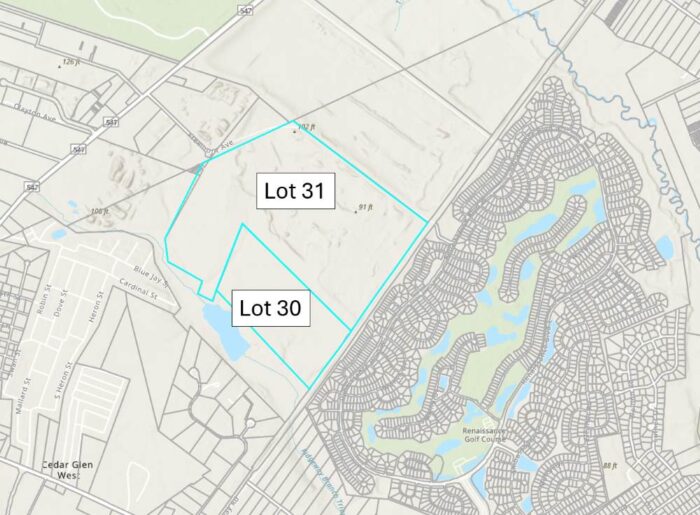
Now when it comes to water use, and the looming threat of hyperscale data centers that use around a million gallons of water per day, the Pinelands also has protections—but there are loopholes that should be addressed. Although the Pinelands Commission would not allow new wells to be drilled that exceed 50,000 gallons of water per day in areas where water supplies are already stressed—this doesn’t prevent towns from selling out their own residents and kneecapping future development.
Data centers can tap into municipal water supplies and use up whatever is left in their allocation—which is the amount of water that the DEP or Pinelands Commission has already approved for the town to distribute as it wishes. By committing large volumes to data centers, municipalities may be leaving their own residents high and dry—both current and future—since additional water for additional needs may no longer be available, with all of the buffer capacity pumped to data centers instead. But if a data center were to require a new well, then this would eliminate most properties on the west side of the Pinelands, which lack the water resources to support large new uses.
As data centers innovate in their resource consumption, water may not be a limiting resource much longer. In the case of the Vineland data center, the facility plans to store the 20 million gallons of water in a closed loop system that it needs for annual use. The Environmental Impact Statement, released February 24, 2026 (after the facility was already built and running) claims that the “Project will be a net generator of water”, producing more than it uses. The specific process is that water is generated as a byproduct of natural gas combustion and is recovered through the wet scrubber and SKYLEA (for which we cannot find a functional website) exhaust gas treatment systems. Any water generated in excess of their needs would be treated and provided to the City of Vineland Water Utility to reduce its current aquifer withdrawal. If this technology works out then it may serve as a model for other data centers—at least in terms of water usage, as the typical hyperscale data center uses approximately one million gallons of water per day.
Concerns Over Noise and Other Factors Resonate with Pinelands Commissioners
One important aspect that the Pinelands CMP does not seem to address: the loud and constant sound that is emitted by data centers. Iconic pine barrens species such as the pine barrens tree frog and barred tree owl are nocturnal, and rely on sound for important life cycle activities like mating. When humans living near data centers area already reporting interruptions to their physical well-being, would we not also find similar effects on the wildlife? The Pinelands Commission requires a space buffer between development and sensitive wetland ecosystems. Is 300 feet enough to protect wildlife from the impacts of constant sound emitted from a data center?
The post-presentation discussion included the fate of land-based data centers once data centers in space render them obsolete, with suggestions that data centers have a decommissioning plan. This reflects widespread concerns that data centers could be the new warehouses—many of which are sitting empty in the Pinelands because they were built on spec with solid plan for use. There was also the concern that the term “light industrial” may be too vague—as it is not defined by the Pinelands CMP—and could be a gateway for new data center development.
Other relevant environmental topics that did not receive much attention include PFAS that is being used in the water systems, and heat islands being created or exacerbated by the cooling mechanisms. Additionally, energy use is a widespread concern, but is not regulated by the Pinelands Commission, despite the negative impacts that climate change has on all ecosystems, including the Pinelands.
Does the CMP Need Updates?
What is already on the books for the Pinelands CMP offers a surprising amount of protection from emerging threats like data centers—but it can always be improved.
Over the years, amendments have been made to the CMP that tweak its protections in light of the latest science and advocacy from groups like the Pinelands Alliance. The process of amending the CMP typically takes about a year, with many bureaucratic and public engagement hurdles to accomplish, so this task is not undertaken lightly. However, the momentum is almost always in the direction of being more protective. A recent great example of this process at work includes the Kirkwood-Cohansey aquifer rules that made the protections against excessive water withdrawal mentioned above possible. The process is not nimble, but much of this is due to the public engagement and due diligence that the process requires.
This whole discussion highlights the strength of the way that the Pinelands CMP was written. Commissioner Rittler-Sanchez remarked: “I’m impressed that something that was written over 30 years ago really holds up pretty well, because we’ve always focused on what we want to protect, not necessarily what exactly we want to protect it from in specifics because that changes all the time. But the fact that we can write something like the CMP and it’ll hold up because we know the values of what we want, protecting what is really important.”
Towns Making Decisions with Regional Impacts
Even though there is potential for data centers to be built in some Pinelands locations, it is not fully possible until towns change their zoning to welcome them. Only two municipalities, Manchester and Monroe township, had ordinances on the books that would allow them to be built. Monroe township council recently reversed this.
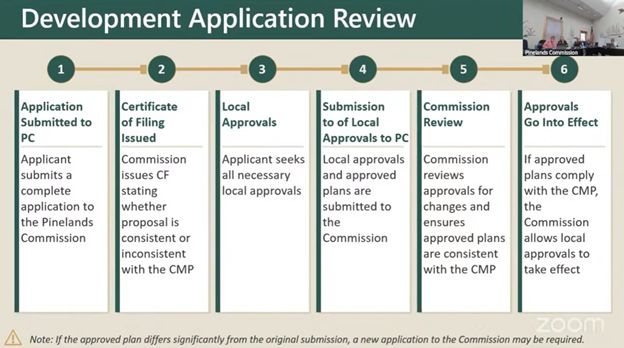
Could something be built as a warehouse and then be converted into a data center in a bait-and-switch maneuver? That would be tricky in the Pinelands, because such a major change of use would require a whole new application to the Pinelands Commission. For a helpful review of the Commission’s review process, staff included the following graphic in their presentation:
Pinelands Alliance maintains that individual municipalities should not be making decisions like this with regional impacts. However, since this decision-making power still sits at the municipal level, the most important thing to do is pay attention to attend your town council meetings and let them know your thoughts. Personal anecdotes can be particularly powerful, like one commenter from Cherry Hill who works for a multinational company and recently had “AI” added to her job title described the expansion of data centers as “so short-sighted, so irresponsible, it hurts.”
Specific actions you can take:
- Sign the petition urging the governor to enact a statewide moratorium on new data centers in New Jersey for at least three years.
- Ask your town council to adopt an ordinance explicitly prohibiting data centers as a permitted use in your municipality—like Pemberton Township already did. View a model ordinance here.
Sweet Amalia Restaurant Owners Plead Their Case Before the Pinelands Commission
Sweet Amalia, a popular restaurant in Franklin Township, has announced it will not open this season due to an ongoing regulatory issue with the Pinelands Commission. This primarily boils down to a septic issue, which we described in detail in a recent blog post. The restaurant owners have since proposed an interim plan to allow the restaurant to reopen in a reduced form while gathering data for a longer-term solution. However, the application remains under review, and until it is approved, the restaurant cannot legally operate with seating.
At the April 10 meeting of the Pinelands Commission, owners Ed Pappas and Melissa McGrath made a direct appeal for a collaborative path forward that would allow the restaurant to reopen this season. McGrath spoke about the care and effort behind the business, while Pappas emphasized their good-faith efforts since 2023 to bring the project into compliance. Watch the full public comments on the Pinelands Commission YouTube channel. From our perspective at the Pinelands Alliance, the remaining challenges appear manageable, but the process has been complicated by evolving plans and a lack of clear, real-time communication about what solutions are acceptable. Establishing a more direct and coordinated dialogue could help clarify expectations and move the application toward resolution.
Even if a path forward is identified with the Pinelands Commission, the Township will also need to approve the plan before reopening can occur. One outstanding local issue—unrelated to environmental standards—is whether the ice cream stand use has been abandoned, which could affect parking and other municipal approvals. Addressing both the regulatory and local questions in a coordinated way will be key to getting Sweet Amalia back up and running.
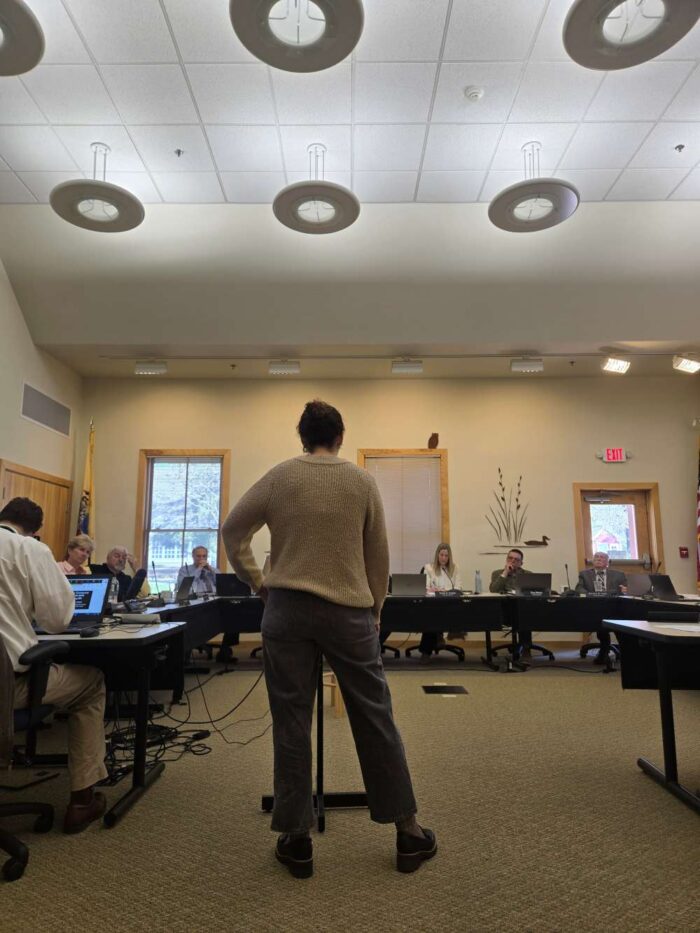
Months since the Pinelands Municipal Council Last Met: 42
Egg Harbor Township recently designated a new representative to the Pinelands council—a role that, at present, comes with limited responsibilities, as the council has not met in over three years.
Municipalities have long valued having a “voice at the table” on Pinelands development issues, but that opportunity has been constrained since 2022. Following the departure of the council’s administrator, regular meetings lapsed, precipitated by the departure of a single administrator who had been managing the emails and buying the sandwiches for meetings. However, this alone does not describe the continued absence of the council, as the Pinelands Commission stands ready to provide administrative support for meetings. More broadly, the situation reflects ongoing challenges related to leadership and participation that we described in a previous blog post.
Reestablishing a consistent forum for Pinelands municipal leaders could provide meaningful benefits, allowing communities to share perspectives, learn from one another, and coordinate approaches to shared challenges such as data center development and the need to provide affordable housing.

My name is Sandra friel
I’ve been living in Monroe township very close to the site where they were planning on putting a warehouse/data center, our township has been fighting it, and they say that they put a band on the data centers, and said that the petition a filing for the hexa corporation was deemed incomplete I don’t know if this is going to be the end of everything or not but I’ve been a very concerned citizen here in Monroe township as I live here and it is my only home I’m worried about the noise pollution the water that it’s going to use up as well as electricity, and many other issues, pertaining to our environment and our quality of life that we are used to I would be happy on any information that you could convey thank you very much